 Indietro
Chapter 4-5
 04:26

Termini in questo insieme (99)
Cells
The fundamental unit of life
Discovery of cells
1665 by Robert Hooke
Natural laws limiting the size of cells:
At minimum, a cell must be large enough to house all of its parts and organelles.
At maximum, it is limited by the amount of surface area it needs to obtain nutrients and dispose of waste.
Plasma membrane
The barrier separating the internal and extracellular environments that controls the flow of materials in and out of the cell
Selective permeability
A property of biological membranes that allows them to regulate the passage of substances across them
Cytpolasm
The interior of the cell
Chromosomes
Structures of DNA that carry genes, formed by condensing chromatin during cell division
Ribosomes
Structures that make proteins according to the instructions in genes
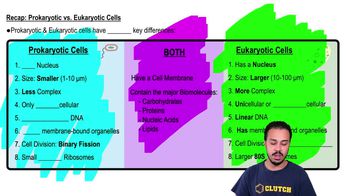
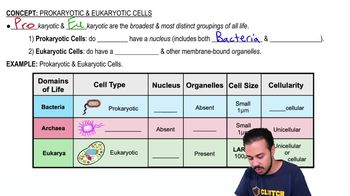
Prokaryotic cells (6)
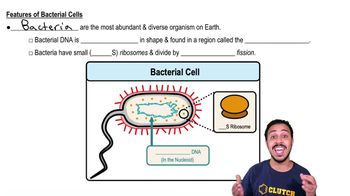
Small, relatively simple
No nucleus or membrane-bound organelles
Contain much less DNA than eukaryotic
Plasma membrane enclosed in a rigid cell wall
Exterior processes called pilli and flagella
Bacteria and archaea
Eukaryotic cells (4)
Larger and much more complex
Contain a nucleus, cytoskeleton, and membrane-bound organelles
Larger genome/more DNA
Animals, plants, fungi and protists
Similarities of prokaryotic and eukaryotic cells (4)
Have plasma membranes
Have cytoplasm
Have chromosomes
Have ribosomes
Differences of prokaryotic and eukaryotic cells (3)
Size (eukaryotic 10x larger)
No membrane-bound organellles (pro) vs complex membrane-bound organelles (euk)
Nucleoid region (pro) vs nucleus (euk)
Nucleoid region
Contains the DNA of a prokaryotic cell, is in direct contact with the cytoplasm (not membrane-bound)
How compartmentalization increases efficiency
Cooperative enzymes are kept close together, incompatible chemical reactions are kept separate
Animal-only organelles
Centrioles - manage cell division and movement
Lysosomes - used to degrade things within the cell
Flagella - cell locomotion
Plant-only organelles
Chloroplasts - for photosynthesis
Rigid cell wall - made of cellulose, for structure
Central vacuole - stores water
Phospholipid bilayer
Found in the plasma membrane, makes cells selectively permeable
Nucleus
Largest organelle in a cell, contains DNA
Nuclear envelope
Separates the nucleus from the cytoplasm
Nuclear pores
Regulate the entry and exit of materials
Nucleolus
Region in the nucleus that synthesizes ribosomal RNA
Chromatin
Formed when DNA interacts with proteins in the nucleus, and is condensed during cell division to form chromosomes
The flow of information in a eukaryotic cell:
DNA -> mRNA -> protein
(Nucleotide) -> nucleotide -> amino acids
Ribosomes
Made of ribosomal RNA and protein, used to carry out protein synthesis. Can be free in the cytosol, or bound to the ER
Endomembrane system
Membranous organelles that manufacture, distribute, and break down cell products
Organelles of the endomembrane system (6):
Nucleus
Endoplasmic reticulum
Golgi apparatus
Lysosomes
Vacuoles
Plasma membrane
Endoplasmic reticulum
A membrane network continuous with the nuclear envelope, distinct from the cytoplasm. 2 regions.
Rough ER
Manufactures membranes, ribosomes on the surface make proteins destined to be outside the cell, on the cell surface, or to the lysosome
Distinguished by the presence of ribosomes
Smooth ER
Synthesizes lipids (cholesterol, fatty acids etc)
Stores calcium
Regulates carbohydrate metabolism and breaks down toxins/drugs in liver cells
Distinguished by the absences of ribosomes
Golgi apparatus
Consists of stacks of membranous sacs
Receives and modifies products form the ER and sends them to other organelles
Can add carbohydrates or lipids to proteins as the proteins mature
Lysosomes
Compartments of degradative enzymes budded off the Golgi apparatus.
Hydrolyzes carbohydrates, proteins, nucleic acids and fats
Lysosomal enzymes in cellular digestion require acidic environments
Vacuoles
Membranous sacs that have lysosomal (digestive) + storage functions (Central vacuole, not often found in animal cells)
Mitochondria
Sites of cellular respiration, harvests chemical energy from food and store it as ATP
ATP
Adenosine triphosphate, the main energy source for cells
Filaments of the cytoskeleton:
Microfilaments of actin enables cells to change shape and move
Intermediate filaments reinforce the cell an anchor certain organelles
Microtubules give cell rigidity, separate chromosomes during cell division, provide anchors for organelles and act as tracks for locomotion
Chloroplasts
Sites of photosynthesis for plants and algae, convert solar energy into chemical energy
Cilia and Flagella
Locomotor appendages that protrude from some cells, made of microtubules wrapped in an extension of the plasma membrane
Extracellular matrix
Sticky layer of glycoprotein used to bind cells together, has protective and supportive functions
Animal cell to cell junctions (3):
Tight junctions - bind cells together into leak-proof sheets
Anchoring junctions - link animal cells to each other
Gap junctions - allow substances to flow form cell to cell
Functions of cell plasma membrane (4)
Boundary between the cell interior and extracellular envionment
Controls what enters an exits the cell (selectively permeable)
Organizes the chemical reactions of the cell
Compartmentalizes groups of enzymes
Cell membrane
A fluid mosaic of lipids, proteins and carbohydrates
Lipids - form a flexible bilayer
Proteins - embedded in the plasma membrane
Carbohydrates - act as identification tags on the other surface of the plasma membrane
Phospholipid bilayer
Amphipathic - hydrophilic heads face outward, hydrophobic tails face inward
Membrane fluidity
Proteins loosely held together with the consistency of salad oil
Saturated fatty acids
Saturated in max number of hydrogen atoms, single-bonded
Straight chain allows maximum interaction between the tails of fatty acids, making the membrane less fluid (more viscous)
Unsaturated fatty acids
Unsaturated in hydrogen atoms, double bonded
Bent chain creates more space between the tails, making the membrane more fluid
Cholesterol
Acts as a fluidity buffer
In warm temps, restrains the movement of phospholipids
In cool temps, maintains fluidity by preventing tight packing of phospholipids
Membrane proteins
Peripheral
Integral
Transmembrane
Peripheral proteins
Located entirely on the surface of lipid bilayer
Ionic and hydrogen bonds interact with hydrophilic lipid and protein groups (1st proteins to leave in the presence of heat)
Integral proteins
Possess hydrophobic regions that are anchored to hydrophobic lipids
Transmembrane proteins
Fully span the membrane, inside and out
Amphipathic
Membrane functions determined by membrane proteins(6):
Transport
Enzymatic activity
Signal transduction
Cell to cell recognition
Intercellular joining
Attachment to cytoskeleton and ER
Membrane carbohydrates
Found on cell exterior, used to help cells “identify” each other
Glycolipids and glycoproteins
Glycolipids
Sugars attached to a lipid, ie antigens that determine blood type
Glycoproteins
Sugars attached to proteins, ie protein receptors
Blood group anitgens
Carbohydrate chains, you make antigens for the blood types you don’t have
Agglutination
Clumping that occurs when an anti-A antibody s in contact with a type A antigen
Selectively permeable membranes:
Hydrophobic (non-polar) molecules dissolve in the lipid bilayer
Polar molecules and ions do not cross the membrane easily (ie water)
Transport proteins
Span the membrane inside and out
Each transport protein is specific to one solute
Channel proteins or carrier proteins
Passive transport
Diffusion across a membrane with no energy investment
Active transport
Molecules/atoms moving through membranes by using energy
Diffusion
The tendency of particles to spread out spontaneously from an area of high concentration to an area of lower concentration (passive transport)
Equilibrium
Two solutes disperse simultaneously until there are equal concentrations of both solutes
Osmosis
The diffusion of water across a selectively permeable membrane, from high water concentration to lower water concentration
Hypertonic
A higher solute concentration compared to the inside of a cell
Hypotonic
A lower solute concentration compared to the inside of the cell
Isotonic
Equal concentrations of solute inside and outside of the cell
Osmoregulation
The control of water balance in order to adapt to an environment
Cells will _____ in a hypertonic solution
Shrink
Cells will _____ in a hypotonic solution
Swell
Plant cells in different concentrations:
Turgid in hypotonic (cell wall prevents membrane rupture)
Flaccid in isotonic
Plasmolyzed in hypertonic (wilted and drooping)
Facilitated diffusion
A form of passive transport where substances move down their concentration gradient via transport proteins
Active transport (3):
Primary active transport
Secondary active transport
Bulk transport
Transport proteins
Can move solutes across a membrane against their concentration gradient, ex Na+/K+ pump
Endocytosis
The movement of large molecules or particles to the inside of a cell
The cell membrane folds inward and traps material in vesicles (very high energy)
Exocytosis
The movement of large molecules or particles to the outside of the celll
A membrane-bound vesicle fuses with the membrane to expel its contents
Energy
The capacity to perform work
Living cells transform energy in enzyme-controlled chemical reactions
Kinetic energy
Energy associated with motion, ex heat and light
Potential energy
Stored energy
Chemical potential energy
Energy stored in bonds/molecules
Chemical energy
When a chemical reaction releases the potential energy stored in bonds and transforms it to kinetic energy, ex a car burning gas
Thermodynamics
The study of energy transformations
1st Law of thermodynamics
Energy can be changed from one form to another, but can never be created or destroyed
2nd law of thermodynamics
No energy change is 100% efficient, some energy is always lost to entropy (always as heat)
Entropy
A measure of disorder
If a system becomes more ordered, its surroundings become more disordered
Heat
Disordered energy/entropy
Catabolic reactions
Energy is released by breaking down complex molecules into simpler compounds (exergonic)
Anabolic reactions
Energy is consumed to build complex molecules from simpler molecules (energonic)
Energy coupling
ATP synthesis requires energy (endergonic), ATP hydrolysis releases energy (exergonic)
ATP
A renewable resource used to drive almost all endergonic reactions
A temporary form of stored chemical energy
Glycolysis
The universal ATP generation pathway, turns glucose into pyruvate
In the cytoplasm, glycolysis reactions break a glucose molecule into two pyruvate molecules, producing two ATP molecules
2 ways pyruvate generates energy
Cellular respiration
Fermentation
Cellular respiration
Aerobic respiration
When oxygen is available, pyruvate is used in the mitochondria to generate more ATP
Fermentation
Anaerobic conditions
When oxygen is not available, glycolysis makes 2 ATP molecules per one glucose molecule (less efficient)
Fermentation regenerates the organic molecule used by glycolysis
Activation energy
The amount of energy reactants must absorb to overcome an energy barrier to start a chemical reaction
Often supplied in the form of heat from surroundings
Organisms can use enzymes instead of heat
Individual enzymes
Catalyize specific individual chemical reactions, and have specific optimal environments determined by the protein’s tertiary structure
Substrate
The specific reactant on which an enzyme acts
Active site
The site on an enzyme to which the substrate binds
Competitive inhibitors
Bind to an enzyme’s active site to block substrates from entering in order to lower enzyme productivity
Non-competitive inhibitors
Bind to the enzyme somewhere other than the active site in order to change the enzyme’s shape and block substrates binding/inhibit enzyme activity