 Indietro
Chapter 4 exam
 04:21

Termini in questo insieme (21)
What is energy
Energy is the capacity to do work or cause change, required for all cellular processes.
Work = Force x Distance moved; energy is needed to perform work in cells.
Potential energy is stored energy (e.g., in chemical bonds).
Kinetic energy is energy of motion (e.g., muscle contraction).
ATP is the cell's energy currency; breaking its bonds releases energy to drive cellular processes.
Energy can be converted but cannot be created or destroyed; some energy is lost as heat during conversions.
Entropy is disorder or randomness; living things must work to counteract increasing entropy.
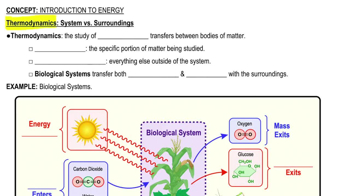
Energy flows from the sun to producers (via photosynthesis) and then to consumers; energy is not recycled.
Producers convert solar energy to chemical energy via photosynthesis; consumers obtain energy by eating producers.
Photosynthesis occurs in chloroplasts, organelles containing chlorophyll, the primary pigment.
Inputs: H2O and CO2. Outputs: O2 and sugars (glucose).
Light reactions capture sunlight to produce ATP and NADPH; Calvin cycle uses these to synthesize sugars.
The Calvin cycle produces a 3-carbon sugar called G3P, which plants use to make glucose.
Cellular respiration is the process of breaking down glucose using oxygen to produce ATP, with CO2 and H2O as by-products.
Photosynthesis stores energy in glucose; cellular respiration releases that energy for cellular work. Products of one are reactants of the other.
Aerobic respiration requires oxygen, occurs in mitochondria, and produces more ATP than anaerobic processes.
Aerobic uses oxygen and produces more ATP; anaerobic occurs without oxygen, producing less ATP and by-products like lactic acid.
A calorie is the amount of chemical energy stored in food; a nutritional Calorie (capital C) equals 1,000 calories (kilocalorie).
Carbohydrates are broken down into glucose, which enters glycolysis to begin cellular respiration.
Glycolysis (cytoplasm, no O2), Krebs cycle (mitochondria), and electron transport chain (mitochondria, requires O2) produce most ATP.
When oxygen is low, glycolysis continues producing ATP and pyruvic acid converts to lactic acid, which can cause muscle fatigue.
Stored ATP supplies about 5 seconds; creatine phosphate provides about 15 seconds of additional energy.