 Indietro
Chapter 5
 01:17

Termini in questo insieme (20)
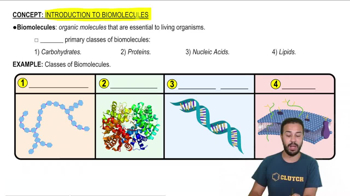
Organic molecules are built mostly from carbon atoms.
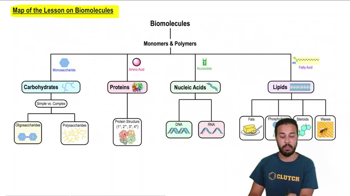
Lipids are not true polymers, unlike carbohydrates, proteins, and nucleic acids.
A monomer is a single building block; a polymer is a chain of many monomers joined together.
Dehydration synthesis builds polymers by removing water (H2O).
Hydrolysis breaks polymers by adding water (H2O) to split bonds.
Monosaccharides have the formula \((CH_2O)_n\), where n = 3 to 7.
Glucose, fructose, and galactose all have the formula C6H12O6 but differ in atom arrangement.
They are stereoisomers differing by the flipped position of an -OH group on carbon 4.
Fructose has a ketone group (C=O in the middle), while glucose and galactose have an aldehyde group (C=O at the end).
In alpha glucose, the OH on carbon 1 points down; in beta glucose, it points up.
It determines whether enzymes can break down polysaccharides like starch (alpha) or cellulose (beta).
A disaccharide is two monosaccharides linked by a glycosidic bond.
Sucrose: glucose + fructose; maltose: glucose + glucose; lactose: glucose + galactose.
A glycosidic bond is the covalent bond joining sugar monomers in disaccharides and polysaccharides.
Formed by dehydration synthesis (water removed), broken by hydrolysis (water added).
Polysaccharides are long chains of monosaccharides used for energy storage or structural support.
Starch is a storage polysaccharide of alpha glucose in plants; animals digest it for energy.
Cellulose is a structural polysaccharide of beta glucose; humans lack enzymes to break beta linkages.
They rely on gut microorganisms that produce enzymes to break beta glycosidic bonds.
Both have 1–4 linkages, but starch has alpha glucose all oriented the same way; cellulose has beta glucose alternating orientation.