 Indietro
Chapter 7
 01:44

Termini in questo insieme (27)
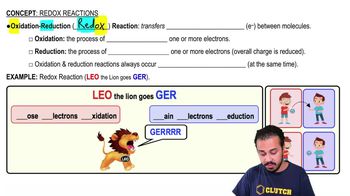
A reaction involving the transfer of electrons between molecules.
Oxidation is the process of losing one or more electrons.
Reduction is the process of gaining one or more electrons.
Nicotinamide adenine dinucleotide in its reduced form.
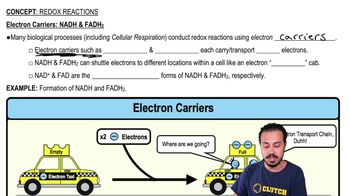
They act as electron carriers, transporting electrons to the electron transport chain.
The oxidized form of NADH, having lost electrons.
The oxidized form of FADH2, having lost electrons.
LEO the lion says GER: Losing Electrons is Oxidation, Gaining Electrons is Reduction.
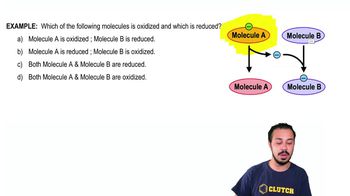
A molecule loses electrons.
A molecule gains electrons.
Molecules like NADH and FADH2 that transport electrons during cellular respiration.
Because they transport electrons to different locations within a cell.
Negative.
Flavin adenine dinucleotide in its reduced form.
They are the oxidized forms that accept electrons to become NADH and FADH2.
They occur simultaneously; one molecule is oxidized while another is reduced.
The presence of hydrogen, indicating the reduced form of the molecules.
Electrons are transferred from one molecule to another, driving the reactions.
It is crucial for understanding metabolic pathways and energy transfer in biological systems.
A molecule has lost electrons.
A molecule has gained electrons.
Both carry a maximum of 2 electrons, but FADH2 also carries 2 hydrogen ions.
It is where energy from electrons is used to produce ATP during cellular respiration.
It becomes NADH.
It becomes FADH2.
Because electrons lost by one molecule are gained by another.
Hydrogen ions are picked up along with electrons to form the reduced versions of these carriers.