 Indietro
chapter 8 con't nov 2nd
 08:09

Termini in questo insieme (25)
what are somatic cells?
typical human body cells that have 46 chromosomes (23 matched chromosomes) with 2 of each chromosomes. Each is duplicated chromosomes has TWO joined sister chromatids.
what are homologous chromosomes and what do they do?
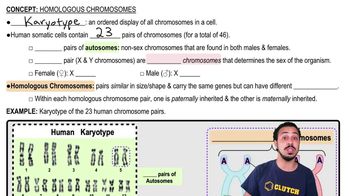
they are pairs of chromosomes that match in length, centromere position, and staining pattern. They carry genes for same inherited characters. (may be different versions of gene).
what is Locus on a chromosome?
The specific position on a chromosome where a gene is located.
Autosomes are all chromosomes except sex chromosomes; humans have 44 autosomes (22 sets of homologous chromosomes.
Sex chromosomes are chromosomes that determine sex of individual (X and Y chromosomes and only part of these are homologous) we got 2 sex chromosomes.
Diploid (2n) cells have two sets of chromosomes (46 in humans), and more higher organisms are diploid. ; Haploid (1n) cells have one set of chromosomes (23 in humans), occurs in gametes.
Life cycle in sexually reproducing organisms?
Sequence from fertilization to offspring production, involving diploid and haploid stages (7). 1. diploid adults. 2. meiosis. 3. haploid gametes (sperm and egg). 4. Fertilization. 5. diploid zygote. 6. mitosis and development. 7. back to diploid adult.
Purpose of meiosis?
Reduces chromosome number by half to produce haploid gametes, ensuring genetic diversity. during INTERPHASE: Chromosomes duplicate.
Homologous chromosomes pairs separated/packaged in sperate 2 haploid daughter cells, crossing over occurs; results in two haploid cells with duplicated chromosomes AKA 2 joined sister cells.
2 Sister chromatid separate, producing four haploid daughter cells with single chromosomes (one chromatid).
Exchange of genetic material between non-sister chromatids of homologous chromosomes during Prophase I, increasing genetic variation.
what is Chiasma?
The X-shaped region where crossing over occurs between homologous chromosomes.
what is genetic variation and Independent assortment?
genetic variation: Arrangement of homologous chromosome pairs at metaphase I affecting resulting gametes.
Independent assortment: Orientation of tetrads is random (which is closer to which pole).
Number of possible chromosome combinations in human gamete?
Approximately 2^n = \(2^{23}\) or 8.4 million possible haploid combinations of chromosomes due to independent assortment.
What is random fertilization effect on genetic variation?
egg and sperm each have 8.4 million combinations SOO if you multiple egg by sperm that = 7 TRILLION different combinations for ONE zygote. NO 2 siblings will be exactly the same.
What are recombinant chromosomes?
Chromosomes that carry DNA from two different parents with a average of 1-3 crossovers [er chromosome pair. (resemble cut and paste of 2 original chromosomes.
Two identical copies of a duplicated chromosome, joined at the centromere.
What is the Centromere's function?
Region where sister chromatids are joined and where spindle fibers attach during cell division.
What happens in Metaphase I (chromosome alignment)?
Homologous chromosome pairs (tetrads) align at the metaphase plate with spindle fibers attached to kinetochores at the centromeres. (held together.)
What happens in Anaphase I (chromosome movement)?
Homologous chromosomes separate and move to opposite poles walked by "motor proteins" along microtubules; sister chromatids remain attached to each other and ONLY tetrads separate.
Telophase I and cytokinesis outcome?
chromosomes arrive at poles, each pole having haploid chromosome set (both still doubled=2 sister chromatids). Separate and 2 haploid daughter cells formed.
Sister chromatids separate and move to opposite poles, resulting in single chromosomes in daughter cells.
Four haploid daughter cells form, each with single chromosomes.
What is sex V.S gender?
Sex: Classification into groups w/ shared anatomical/physiological traits which is determined based on chromosomes. Sex isn't a binary state.
Gender: Persons who identity of male, female, etc.
Both determined by many genes, many not associated w/ sex chromosomes.
Is prophase I and metaphase I the same as prophase II and metaphase II?
YESSSS.
What are the stages for Meiosis 1 and 2?
All go like:
Prophase-Metaphase-Anaphase-Telophase-Cytokinesis.