Skip to main content
General Biology
Il mio corso
Impara
Preparazione agli esami
AI Tutor
Guide di studio
Soluzioni per libri di testo
Flashcard
Esplora
Prova l'app
Il mio corso
Impara
Preparazione agli esami
AI Tutor
Guide di studio
Soluzioni per libri di testo
Flashcard
Esplora
Prova l'app
Indietro
Chemical Bonds in General Biology
Puoi toccare per girare la carta.
What are chemical bonds?
Puoi toccare per girare la carta.
👆
What are chemical bonds?
Chemical bonds
are attractions that hold atoms together when they share or transfer valence electrons to fill their outer shells.
Avanzamenti del tracciato
I pulsanti di controllo sono stati cambiati in modalità "navigazione".
1/20
Video consigliati
1:59
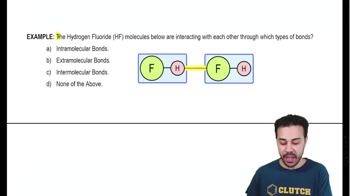
Introduction to Chemical Bonding Example 1
10316
views
188
rank
03:53
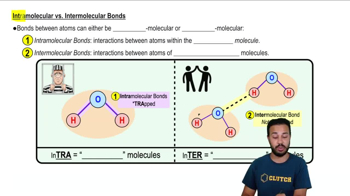
Intramolecular vs. Intermolecular Bonds
24668
views
481
rank
1
comments
02:42
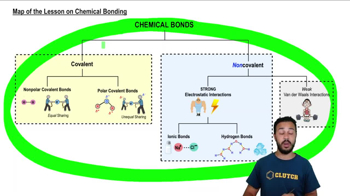
Map of the Lesson on Chemical Bonding
24379
views
329
rank
Termini in questo insieme (20)
Nascondere definizioni
What are chemical bonds?
Chemical bonds
are attractions that hold atoms together when they share or transfer valence electrons to fill their outer shells.
Name the main types of chemical bonds.
Covalent bonds, Ionic bonds, Hydrogen bonds, Van der Waals interactions, and Disulfide bridges.
What is a covalent bond?
A
covalent bond
is the sharing of a pair of valence electrons between two atoms, counting as part of each atom's valence shell.
What types of covalent bonds exist?
Single bonds share 1 pair, double bonds share 2 pairs, and triple bonds share 3 pairs of valence electrons.
How are atomic bonds represented?
Structural formulas show atom arrangements and bond types; molecular formulas show the exact kind and number of atoms.
What is electronegativity?
Electronegativity
is an atom's attraction for electrons in a covalent bond; more electronegative atoms pull electrons more strongly.
Difference between non-polar and polar covalent bonds?
Non-polar covalent bonds share electrons equally; polar covalent bonds share electrons unequally due to differing electronegativities.
What causes a polar molecule?
Unequal sharing of electrons in a polar covalent bond causes partial positive and negative charges, forming a
polar molecule
.
What is an ionic bond?
An
ionic bond
forms when atoms transfer electrons, creating oppositely charged ions (cations and anions) that attract each other.
What are cations and anions?
Cations are positively charged ions; anions are negatively charged ions formed after electron transfer.
What are ionic compounds or salts?
Compounds formed by ionic bonds, like sodium chloride (NaCl), often found as crystals in nature.
Role of weak chemical bonds in organisms?
Weak bonds like ionic, hydrogen, Van der Waals, and disulfide bridges reinforce molecular shapes and help molecules adhere.
What is a hydrogen bond?
A
hydrogen bond
forms when a partially positive hydrogen atom of one polar molecule is attracted to a partially negative atom of another.
What are Van der Waals interactions?
Attractions between molecules close together due to uneven electron distribution creating temporary 'hot spots' of charge.
Why is molecular shape important in biology?
Molecular shape determines function and interaction; molecules with similar shapes can have similar biological effects.
What determines a molecule's shape?
The positions of atoms' valence orbitals determine the shape of a molecule.
How do biological molecules recognize each other?
Recognition and interaction depend on molecular shape complementarity.
Example of molecules with similar shapes having similar effects?
Natural endorphins and morphine have similar shapes and bind to the same receptors, producing similar effects.
What is a molecule?
A molecule consists of two or more atoms held together by covalent bonds.
What is bonding capacity or valence?
The number of covalent bonds an atom can form, determined by its valence electrons.
 IndietroIndietro
 1:59