Skip to main content
General Biology
Il mio corso
Impara
Preparazione agli esami
AI Tutor
Guide di studio
Soluzioni per libri di testo
Flashcard
Esplora
Prova l'app
Il mio corso
Impara
Preparazione agli esami
AI Tutor
Guide di studio
Soluzioni per libri di testo
Flashcard
Esplora
Prova l'app
Indietro
Chemical Context of Life - General Biology
Puoi toccare per girare la carta.
What is matter?
Puoi toccare per girare la carta.
👆
What is matter?
Matter
is anything that takes up space and has mass.
Avanzamenti del tracciato
I pulsanti di controllo sono stati cambiati in modalità "navigazione".
1/20
Video consigliati
02:13
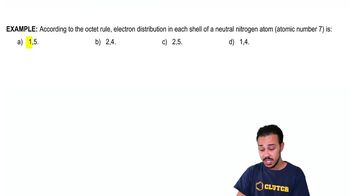
Atoms- Smallest Unit of Matter Example 1
30372
views
792
rank
2
comments
03:51
Atoms- Smallest Unit of Matter Example 3
19760
views
424
rank
1
comments
09:44
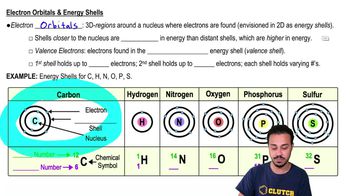
Electron Orbitals & Energy Shells
27492
views
588
rank
3
comments
Termini in questo insieme (20)
Nascondere definizioni
What is matter?
Matter
is anything that takes up space and has mass.
Define an element.
An
element
is a substance that cannot be broken down to other substances by chemical reactions.
What is a compound?
A
compound
is a substance consisting of two or more elements in a fixed ratio with different characteristics from its elements.
What is an atom?
An
atom
is the smallest unit of matter that retains the properties of an element.
Name the three main subatomic particles and their charges.
Neutrons
(no charge),
protons
(positive charge), and
electrons
(negative charge).
Where are protons and neutrons located in an atom?
Protons and neutrons form the
atomic nucleus
at the center of the atom.
What determines an element's atomic number?
The
atomic number
is the number of protons in the nucleus of an atom.
What is an isotope?
Isotopes are atoms of the same element with the same number of protons but different numbers of neutrons.
How does electron distribution affect chemical behavior?
The distribution of electrons in electron shells determines an atom's
chemical behavior
.
What are valence electrons?
Valence electrons are the electrons in the outermost shell that determine an atom's chemical reactivity.
What is a covalent bond?
A
covalent bond
is the sharing of a pair of valence electrons between two atoms.
Difference between single and double covalent bonds?
A
single bond
shares one pair of electrons; a
double bond
shares two pairs.
What is electronegativity?
Electronegativity is an atom's attraction for electrons in a covalent bond.
Describe a nonpolar covalent bond.
In a
nonpolar covalent bond
, electrons are shared equally between atoms.
Describe a polar covalent bond.
In a
polar covalent bond
, electrons are shared unequally, causing partial charges.
What is an ionic bond?
An
ionic bond
is the attraction between oppositely charged ions formed by electron transfer.
Define cation and anion.
A
cation
is a positively charged ion; an
anion
is a negatively charged ion.
What are salts in chemistry?
Salts are
ionic compounds
formed by ionic bonds, often found as crystals.
What is a hydrogen bond?
A
hydrogen bond
forms when a hydrogen atom covalently bonded to one electronegative atom is attracted to another electronegative atom.
Why are hydrogen bonds important?
Hydrogen bonds contribute to the structure and properties of water and biological molecules.
 IndietroIndietro
 02:13
02:13