Skip to main content
General Biology
Il mio corso
Impara
Preparazione agli esami
AI Tutor
Guide di studio
Soluzioni per libri di testo
Flashcard
Esplora
Prova l'app
Il mio corso
Impara
Preparazione agli esami
AI Tutor
Guide di studio
Soluzioni per libri di testo
Flashcard
Esplora
Prova l'app
Indietro
Chemical Context of Life - General Biology
Puoi toccare per girare la carta.
What are the four most abundant elements in living organisms?
Puoi toccare per girare la carta.
👆
What are the four most abundant elements in living organisms?
The four most abundant elements are
oxygen (O)
,
carbon (C)
,
hydrogen (H)
, and
nitrogen (N)
.
Avanzamenti del tracciato
I pulsanti di controllo sono stati cambiati in modalità "navigazione".
1/21
Video consigliati
02:13
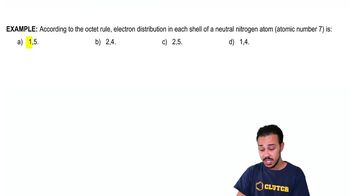
Atoms- Smallest Unit of Matter Example 1
30341
views
790
rank
2
comments
03:51
Atoms- Smallest Unit of Matter Example 3
19737
views
424
rank
1
comments
09:44
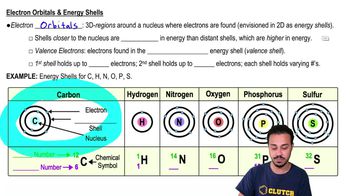
Electron Orbitals & Energy Shells
27462
views
588
rank
3
comments
Termini in questo insieme (21)
Nascondere definizioni
What are the four most abundant elements in living organisms?
The four most abundant elements are
oxygen (O)
,
carbon (C)
,
hydrogen (H)
, and
nitrogen (N)
.
Define an atom.
An
atom
is the smallest unit of matter that retains the properties of an element.
What subatomic particles make up an atom?
Atoms are made of
protons
(positive charge),
neutrons
(neutral), and
electrons
(negative charge).
What determines the atomic number of an element?
The
atomic number
is the number of protons in the nucleus of an atom.
What is an isotope?
Isotopes are atoms of the same element with the same number of protons but different numbers of neutrons.
Explain the concept of atomic mass.
Atomic mass is the total number of protons and neutrons in an atom's nucleus.
What is a chemical bond?
A
chemical bond
is an attraction that holds atoms together in molecules.
Describe an ionic bond.
An
ionic bond
forms when one atom transfers electrons to another, creating oppositely charged ions that attract.
Describe a covalent bond.
A
covalent bond
forms when two atoms share one or more pairs of electrons.
What is electronegativity?
Electronegativity is an atom's tendency to attract shared electrons in a covalent bond.
What is a polar covalent bond?
A
polar covalent bond
occurs when electrons are shared unequally due to differences in electronegativity.
What is a hydrogen bond?
A
hydrogen bond
is a weak attraction between a hydrogen atom in one molecule and an electronegative atom in another.
Why is water considered a polar molecule?
Water is polar because oxygen is more electronegative than hydrogen, causing an uneven distribution of charge.
What properties of water arise from its polarity and hydrogen bonding?
Water has high cohesion, adhesion, specific heat, and solvent abilities due to polarity and hydrogen bonding.
Define cohesion in water.
Cohesion is the attraction between water molecules due to hydrogen bonding.
Define adhesion in water.
Adhesion is the attraction between water molecules and other substances.
What is the significance of water's high specific heat?
Water's high specific heat allows it to resist temperature changes, stabilizing environments.
What is an acid in terms of H+ concentration?
An acid increases the concentration of
H+
ions in a solution.
What is a base in terms of H+ concentration?
A base reduces the concentration of
H+
ions, often by releasing
OH-
ions.
What does the pH scale measure?
The pH scale measures the concentration of
H+
ions in a solution, indicating acidity or alkalinity.
What is a buffer?
A buffer is a substance that minimizes changes in pH by accepting or donating
H+
ions.
 IndietroIndietro
 02:13
02:13