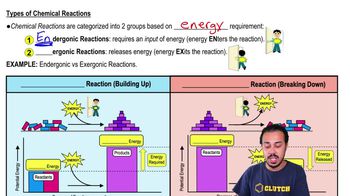
Potential energy is stored energy, including chemical bonds. Kinetic energy is energy of motion, including thermal energy.
What is enthalpy (H) in the context of chemical bonds?
Enthalpy is the potential energy stored in chemical bonds.
How does electron sharing affect bond potential energy?
Bonds with electrons shared equally (nonpolar) are longer and weaker with higher potential energy; unequal sharing (polar) results in shorter, stronger bonds with lower potential energy.
What is enthalpy change (ΔH) in chemical reactions?
ΔH represents heat released or absorbed; exothermic reactions release heat, endothermic absorb heat.
What is entropy (S)?
Entropy is the amount of disorder or energy dispersal in a system.
What does the First Law of Thermodynamics state?
Energy cannot be created or destroyed, only transferred or transformed.
What does the Second Law of Thermodynamics state?
Entropy (disorder) of an isolated system always increases.
What is an isolated system?
A system that cannot exchange energy or matter with its surroundings.
What determines spontaneity of a chemical reaction?
Reactions are spontaneous if the change in Gibbs free energy (ΔG) is negative: \(\Delta G = \Delta H - T\Delta S\).
What is the hydrophobic effect?
Hydrophobic molecules cluster in water to reduce ordered water cages, increasing entropy and driving their association.
What defines an organic molecule?
Molecules containing carbon bonded to other elements, often arranged in chains or rings.
What are functional groups in organic molecules?
Specific groups of atoms attached to carbon that determine molecule properties and reactivity.
Name six common functional groups attached to carbon atoms.
Amino, Carboxyl, Carbonyl (aldehydes and ketones), Hydroxyl, Phosphate, Sulfhydryl.
What are the four major classes of biological macromolecules?
Proteins, Nucleic Acids, Carbohydrates, and Lipids.
How are biological polymers formed?
By condensation reactions that link monomers with covalent bonds, releasing water.
What is hydrolysis in biological molecules?
The addition of water to break covalent bonds in polymers, separating monomers.
How do lipids differ from other macromolecules in structure?
Lipids are not polymers linked by covalent bonds but aggregate due to the hydrophobic effect.
What happens to entropy during polymerization?
Entropy decreases because monomers become ordered in a polymer chain.
What is phosphorolysis?
Degradation of polymers by adding phosphate instead of water, producing phosphorylated monomers.
 Indietro
 01:56
01:56