 Indietro
d FiltrMembrane Transport: Diffusion, Osmosis, anation lab 6
 02:44

Termini in questo insieme (21)
Solute is the substance dissolved in a solvent. Solvent is the fluid that dissolves the solute. A solution is a homogeneous mixture of solute dissolved in solvent.
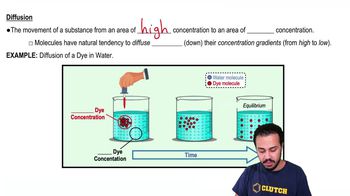
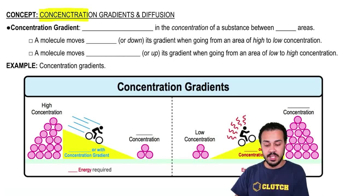
A concentration gradient is the difference in solute concentration between two regions, driving diffusion from high to low concentration.
Diffusion is the passive movement of particles from regions of high concentration to low concentration until equilibrium is reached.
Rate of diffusion increases with higher concentration gradient, higher temperature, smaller molecular weight, and larger membrane surface area and permeability.
Osmosis is the movement of water across a selectively permeable membrane from higher water concentration (lower solute) to lower water concentration (higher solute).
A membrane that allows some molecules (like water, oxygen) to pass but blocks others (like proteins and ions).
Osmotic pressure is the pressure required to stop water movement across a membrane due to osmosis, proportional to the osmotic potential (solute concentration difference).
Hypertonic: higher solute concentration; Hypotonic: lower solute concentration; Isotonic: equal solute concentration compared to another solution.
Water moves from the hypotonic (lower solute) solution to the hypertonic (higher solute) solution until equilibrium is reached.
Filtration is the process where hydrostatic pressure forces fluid and small particles through a membrane, leaving larger particles behind.
Filtration occurs in the kidneys where blood pressure forces small molecules like urea and ions through membranes into kidney tubules, while proteins remain in blood.
Smaller cells have a higher surface area to volume ratio, allowing more efficient diffusion of substances across the membrane.
Smaller molecules have less mass and move more rapidly, increasing their rate of diffusion compared to larger molecules.
Aquaporins are channel proteins that facilitate faster water movement across the plasma membrane during osmosis.
Higher membrane permeability (larger pores or more channels) increases the rate at which molecules diffuse across the membrane.
Water moves out of the cell into the hypertonic solution, causing the cell to shrink (crenate).
Water moves into the cell from the hypotonic solution, causing the cell to swell and possibly burst (lyse).
Equilibrium is reached when solute concentrations are equal on both sides of the membrane and net movement of particles or water stops.
Higher temperature increases particle kinetic energy, speeding up the rate of diffusion.
Passive transport requires no energy and moves substances down their concentration gradient; active transport requires ATP to move substances against their gradient.
A higher surface area to volume ratio allows more efficient exchange of materials across the cell membrane relative to cell volume.