 Indietro
DNA Replication and Structure - General Biology
 05:45
05:45
Termini in questo insieme (21)
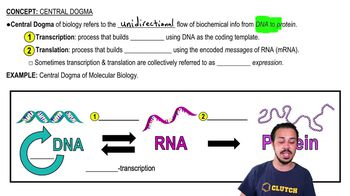
The flow of genetic information: DNA is transcribed into RNA, which is translated into protein. DNA replication copies DNA before cell division.
Life is self-replicating, stores and follows instructions via transcription and translation, and evolves through mutations.
DNA is a double helix of two antiparallel strands made of nucleotide polymers with a sugar-phosphate backbone and nitrogenous bases as rungs.
DNA strands have polarity with a 5' end (phosphate group) and a 3' end (hydroxyl group), running antiparallel to each other.
A nucleotide consists of a 5-carbon deoxyribose sugar, a phosphate group, and a nitrogenous base (A, T, G, or C).
Adenine pairs with Thymine via 2 hydrogen bonds; Guanine pairs with Cytosine via 3 hydrogen bonds, ensuring complementarity.
A phosphodiester bond links the 3' hydroxyl of one nucleotide's sugar to the 5' phosphate of the next, forming the sugar-phosphate backbone.
DNA polymerase synthesizes new DNA strands by adding nucleotides to the 3' end, using the original strand as a template.
New DNA strands are synthesized in the 5' to 3' direction by DNA polymerase.
The replication fork is the Y-shaped region where DNA helicase unwinds the double helix to allow replication.
Helicase unwinds the DNA double helix by breaking hydrogen bonds between base pairs at the replication fork.
RNA primase synthesizes a short RNA primer to provide a 3' OH group for DNA polymerase to start DNA synthesis.
The leading strand is synthesized continuously; the lagging strand is synthesized discontinuously in Okazaki fragments.
Short DNA fragments synthesized on the lagging strand during replication, later joined by DNA ligase.
DNA ligase seals nicks between Okazaki fragments by forming phosphodiester bonds, completing the lagging strand.
DNA polymerase detects and corrects mismatched nucleotides during replication to reduce mutations.
Each new DNA molecule contains one parental strand and one newly synthesized strand.
A replication bubble forms when two replication forks move in opposite directions, allowing simultaneous DNA synthesis.
Eukaryotic chromosomes have multiple origins of replication to speed up DNA synthesis.
Hydrogen bonds between complementary bases stabilize the DNA double helix but allow strand separation during replication.
DNA strands run in opposite directions: one 5' to 3', the other 3' to 5', essential for replication and base pairing.