Skip to main content
General Biology
Il mio corso
Impara
Preparazione agli esami
AI Tutor
Guide di studio
Soluzioni per libri di testo
Flashcard
Esplora
Prova l'app
Il mio corso
Impara
Preparazione agli esami
AI Tutor
Guide di studio
Soluzioni per libri di testo
Flashcard
Esplora
Prova l'app
Indietro
DNA Structure and Replication - General Biology
Puoi toccare per girare la carta.
Watson & Crick Model of DNA
Puoi toccare per girare la carta.
👆
Watson & Crick Model of DNA
DNA is a
double helix
with antiparallel strands held together by hydrogen bonds between complementary bases (A-T, G-C).
Avanzamenti del tracciato
I pulsanti di controllo sono stati cambiati in modalità "navigazione".
1/21
Video consigliati
08:56
The Griffith Experiment
18027
views
268
rank
Termini in questo insieme (21)
Nascondere definizioni
Watson & Crick Model of DNA
DNA is a
double helix
with antiparallel strands held together by hydrogen bonds between complementary bases (A-T, G-C).
Purpose of DNA Replication
To ensure
genetic information
is accurately passed to daughter cells during cell division.
Griffith's Transformation Experiment
Showed that a
transforming principle
from dead pathogenic bacteria could genetically alter live non-pathogenic bacteria.
Hershey-Chase Experiment
Used radioactive isotopes to show that
DNA, not protein
, is the genetic material injected by phages into bacteria.
Chargaff's Rules
1. Base composition of DNA varies between species. 2. In any species, % of A = T and % of G = C.
Role of Rosalind Franklin
Produced
X-ray crystallographic images
of DNA that enabled Watson and Crick to deduce the double helix structure.
Telomeres
Special nucleotide sequences at the ends of eukaryotic chromosomes that
postpone shortening
during replication.
Telomerase
An enzyme that
lengthens telomeres
in germ cells; inactive in most somatic cells but active in many cancer cells.
Chromatin
Complex of DNA and histone proteins; includes
euchromatin
(loosely packed, active) and
heterochromatin
(densely packed, inactive).
Semi-Conservative Model of DNA Replication
Each new DNA molecule has one old (parental) strand and one newly synthesized strand.
Replication Fork
Y-shaped region where DNA strands are separated and replication occurs.
Key Enzymes in DNA Replication
Helicase
unwinds DNA;
Primase
synthesizes RNA primer;
DNA polymerase
adds nucleotides;
Topoisomerase
relieves strain;
DNA ligase
joins fragments.
Direction of DNA Synthesis
DNA polymerase adds nucleotides only to the
3’ end
, synthesizing DNA in the 5’ to 3’ direction.
Leading vs Lagging Strand
Leading strand is synthesized
continuously
; lagging strand is synthesized
discontinuously
as Okazaki fragments.
Okazaki Fragments
Short DNA fragments synthesized on the lagging strand during DNA replication.
DNA Polymerase Proofreading
DNA polymerases
proofread
newly made DNA, replacing incorrect nucleotides to reduce errors.
Mismatch Repair
Enzymes correct errors missed by DNA polymerase to maintain DNA integrity.
Nucleotide Excision Repair
Removes and replaces damaged DNA segments caused by chemical or physical agents.
DNA Cloning
Inserting DNA into plasmids to create recombinant DNA using
restriction enzymes
and cloning vectors.
Polymerase Chain Reaction (PCR)
Technique to amplify specific DNA segments using cycles of denaturation, annealing, and extension with heat-stable DNA polymerase.
CRISPR-Cas9 System
A genome editing tool using guide RNA to direct Cas9 nuclease to target DNA sequences for cutting and modification.
 IndietroIndietro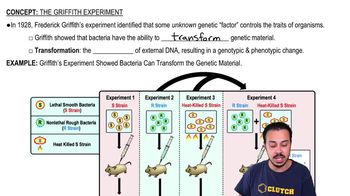
 08:56
08:56