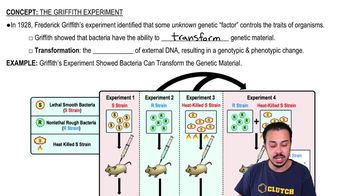
What was the key finding of the Griffith experiment?
Bacteria can transform by taking up external DNA, resulting in genotypic and phenotypic changes.
What did the Hershey-Chase experiment demonstrate?
DNA, not protein, is the genetic material that enters bacteria during bacteriophage infection.
What is a bacteriophage?
A virus that infects bacteria, consisting of a protein coat surrounding nucleic acid.
State Chargaff's rules regarding DNA base composition.
In DNA, %A ≈ %T and %G ≈ %C within a species, but base composition varies between species.
What did Rosalind Franklin contribute to DNA research?
She used X-ray diffraction to capture Photo 51, revealing DNA's helical structure.
Describe the structure of DNA as discovered by Watson and Crick.
DNA is a double helix with two anti-parallel strands and complementary base pairing (A–T, C–G).
What is the significance of DNA strands being anti-parallel?
It allows complementary base pairing and directional synthesis of new strands.
What model of DNA replication was confirmed by the Meselson-Stahl experiment?
The semi-conservative model, where each new DNA molecule has one old and one new strand.
What is the origin of replication (ORI)?
Specific DNA sequences where DNA replication begins.
What are replication forks?
Y-shaped regions where DNA strands separate and replication occurs bidirectionally.
What role does topoisomerase play in DNA replication?
It relieves DNA supercoiling ahead of the replication fork by cutting and rejoining DNA.
What is the function of helicase during DNA replication?
Helicase unwinds the DNA double helix by breaking hydrogen bonds between strands.
What do single-strand binding proteins (SSBs) do?
They bind to and stabilize single-stranded DNA to prevent reannealing and degradation.
In which direction do DNA polymerases synthesize new DNA strands?
DNA polymerases synthesize new strands in the 5' to 3' direction, adding nucleotides to the 3' end.
What is the difference between the leading and lagging strands?
The leading strand is synthesized continuously toward the replication fork; the lagging strand is synthesized discontinuously away from the fork in Okazaki fragments.
What enzyme synthesizes RNA primers during DNA replication?
Primase synthesizes short RNA primers that provide starting points for DNA polymerase.
How are Okazaki fragments joined together?
DNA ligase covalently joins Okazaki fragments to form a continuous strand on the lagging strand.
What proofreading ability do DNA polymerases have?
DNA polymerases have 3' to 5' exonuclease activity that corrects base-pairing errors during replication.
What are telomeres?
Non-coding repetitive DNA sequences at the ends of eukaryotic chromosomes that protect them from degradation.
What is the role of telomerase?
Telomerase extends telomeres in germ and some cancer cells, maintaining chromosome length and cell division capacity.
 Indietro
 08:56
