Skip to main content
General Biology
Il mio corso
Impara
Preparazione agli esami
AI Tutor
Guide di studio
Soluzioni per libri di testo
Flashcard
Esplora
Prova l'app
Il mio corso
Impara
Preparazione agli esami
AI Tutor
Guide di studio
Soluzioni per libri di testo
Flashcard
Esplora
Prova l'app
Indietro
Ecological Communities and Energy Flow in General Biology
Puoi toccare per girare la carta.
What is a biological community?
Puoi toccare per girare la carta.
👆
What is a biological community?
An assemblage of populations of different species living close enough to interact.
Avanzamenti del tracciato
I pulsanti di controllo sono stati cambiati in modalità "navigazione".
1/29
Video consigliati
02:55
Overview: Types of Community Interactions
1856
views
10
rank
02:23
Introduction to Community Interactions Example 1
1999
views
9
rank
01:57
Introduction to Community Interactions
2326
views
21
rank
Termini in questo insieme (29)
Nascondere definizioni
What is a biological community?
An assemblage of populations of different species living close enough to interact.
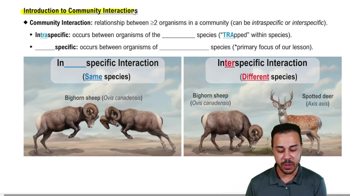
Define interspecific interactions.
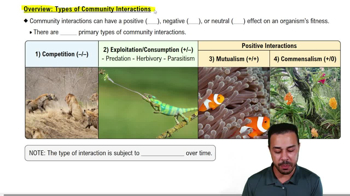
Interactions between species that can be positive (+), negative (−), or neutral (0) affecting survival and reproduction.
What is competition in ecology?
When individuals of different species compete for a limited resource that affects their survival and reproduction.
Explain the principle of competitive exclusion.
Two species competing for the same limiting resource cannot coexist permanently in the same place.
What is an ecological niche?
The specific set of biotic and abiotic resources an organism uses in its environment.
Differentiate between fundamental and realized niche.
Fundamental niche is the potential niche a species can occupy; realized niche is the actual niche occupied when competitors are present.
What is character displacement?
Greater differences in traits between sympatric species than allopatric species, indicating past competition.
Define exploitation in species interactions.
An interaction where one species benefits by feeding on another, which is harmed (includes predation, herbivory, parasitism).
What adaptations do predators have for capturing prey?
Acute senses, claws, fangs, and poison.
List some prey defensive adaptations.
Behavioral (hiding, fleeing), morphological (spines), physiological (toxins), cryptic coloration, and aposematic coloration.
What is aposematic coloration?
Bright warning colors in animals with chemical defenses to deter predators.
Explain Batesian mimicry.
A harmless species mimics a harmful or unpalatable species to avoid predation.
What is herbivory?
An interaction where an herbivore eats parts of a plant or alga, harming but usually not killing it.
Describe parasitism.
One organism (parasite) derives nourishment from another (host), harming the host.
What are mutualism and commensalism?
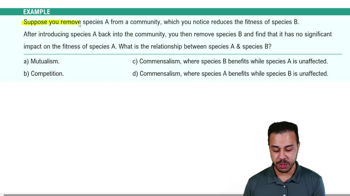
Mutualism benefits both species; commensalism benefits one species without affecting the other.
What are the two components of species diversity?
Species richness (number of species) and relative abundance (proportion of each species).
Define trophic structure.
The feeding relationships between organisms in a community, organized by trophic levels.
What is a food web?
A group of interconnected food chains showing complex trophic interactions.
What is a keystone species?
A species that exerts strong control on community structure through its ecological role, not abundance.
What is ecological disturbance?
An event that changes a community by removing organisms or altering resource availability.
Explain the intermediate disturbance hypothesis.
Moderate disturbance levels promote greater species diversity than high or low disturbance.
What is ecological succession?
The sequential change in community composition following a major disturbance.
Differentiate primary and secondary succession.
Primary succession occurs in lifeless areas; secondary succession occurs where disturbance removed most organisms but soil remains.
How do human activities affect ecosystems?
They cause strong disturbances that often reduce species diversity and alter community structure.
What role do pathogens play in community ecology?
Pathogens can dramatically affect community structure locally and globally by causing diseases.
What is energy flow in ecosystems governed by?
The first and second laws of thermodynamics: energy is conserved but conversions increase entropy and lose heat.
What is the law of conservation of mass in ecosystems?
Matter cannot be created or destroyed; chemical elements are recycled within ecosystems.
What are biogeochemical cycles?
Nutrient cycles involving both biotic and abiotic components, such as water, carbon, nitrogen, and phosphorus cycles.
Why are decomposers important in ecosystems?
They break down organic matter, releasing nutrients back into the environment for recycling.
 IndietroIndietro
 02:55