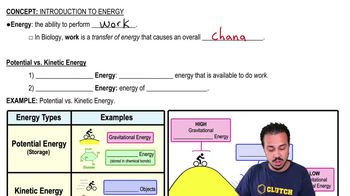
Energy is the ability to perform work, which in biology is a transfer of energy causing an overall change.
Define potential and kinetic energy with examples.
Potential energy is stored energy available to do work (e.g., glucose molecule). Kinetic energy is energy of motion (e.g., water rushing over a waterfall).
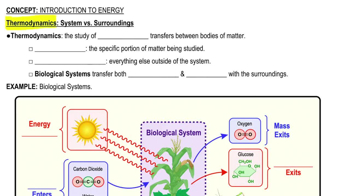
What is a biological system in thermodynamics?
A system is the specific portion of matter studied, while surroundings are everything else. Biological systems transfer both energy and matter with surroundings.
State the First Law of Thermodynamics.
Energy cannot be created or destroyed, only transferred or transformed. The total energy in the universe remains constant.
What does entropy measure?
Entropy measures disorder or randomness; higher disorder means higher entropy. Natural reactions tend to increase universal entropy.
Explain the Second Law of Thermodynamics in biological context.
No energy transfer is 100% efficient; some energy is lost as heat, increasing the entropy of the universe.
What are reactants and products in a chemical reaction?
Reactants are starting materials, and products are the resulting materials after bonds are made or broken.
Differentiate between endergonic and exergonic reactions.
Endergonic reactions require energy input (energy enters), while exergonic reactions release energy (energy exits).
What is ATP and its role in cells?
Adenosine Triphosphate (ATP) is a high-energy molecule that powers cellular activities by hydrolyzing phosphate bonds to release energy.
Describe ATP hydrolysis.
Breaking bonds between phosphate groups in ATP releases energy and forms ADP; sometimes ADP can be further hydrolyzed to AMP.
What is energy coupling in metabolism?
Energy released by exergonic reactions (like ATP hydrolysis) is used to drive endergonic reactions, providing necessary energy input.
Define phosphorylation and its effects.
Phosphorylation is the transfer of a phosphate group from ATP to another molecule, which can activate the molecule or change protein shape.
What is an enzyme and its function?
An enzyme is a catalyst that speeds up chemical reactions without being consumed, by lowering activation energy.
List some functions of enzymes in cells.
Enzymes build molecules, copy DNA, and break down food molecules.
Name environmental factors affecting enzyme activity.
Temperature, pH, and substrate concentration affect enzyme activity; extreme conditions can denature enzymes and reduce activity.
What is activation energy (EA)?
Activation energy is the minimum energy required to start a chemical reaction by reaching the transition state.
How do enzymes affect activation energy?
Enzymes lower the activation energy barrier, allowing reactions to proceed faster.
Describe the enzyme-substrate complex.
A substrate binds to an enzyme's active site forming the enzyme-substrate complex; after catalysis, products are released and enzyme remains unchanged.
What are cofactors and coenzymes?
Cofactors are non-protein helpers (e.g., metal ions) required for enzyme activity; coenzymes are organic cofactors derived from vitamins.
Explain competitive and noncompetitive enzyme inhibition.
Competitive inhibitors bind the active site competing with substrate; noncompetitive inhibitors bind allosteric sites, changing enzyme shape and activity.
What is metabolism and metabolic pathways?
Metabolism is the sum of all chemical reactions in an organism; metabolic pathways are series of reactions modifying substrates stepwise.
 Indietro
 04:21