 Indietro
Energy, Enzymes, and Metabolism in General Biology
 04:21

Termini in questo insieme (20)
Metabolism is the collection of all enzymatic reactions that occur in an organism, including both catabolic and anabolic pathways.
Catabolism breaks down molecules and releases energy. Anabolism builds macromolecules and consumes energy.
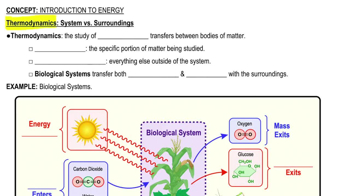
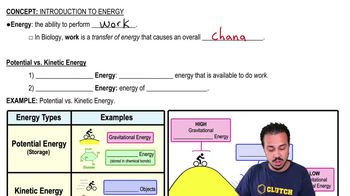
Energy cannot be created or destroyed; it is conserved in the universe.
Every energy transfer increases the entropy (disorder) of the universe; some energy is lost as heat.
Free energy is the portion of a system's energy that can perform work, calculated as \(\Delta G = \Delta H - T\Delta S\).
Exergonic reactions release energy (ΔG < 0). Endergonic reactions require energy input (ΔG > 0).
ATP (adenosine triphosphate) is the main energy currency of the cell, coupling exergonic reactions to endergonic cellular work.
Hydrolysis of ATP releases energy by breaking a phosphate bond, which drives mechanical, transport, and chemical work.
Activation energy is the energy barrier that must be overcome for a chemical reaction to proceed.
Enzymes lower the activation energy, speeding up reactions without changing the overall ΔG.
The active site is the specific region where substrates bind and the catalytic reaction occurs.
Substrate binding induces a shape change in the enzyme, enhancing substrate binding and catalysis.
Cofactors are inorganic ions (e.g., zinc, iron). Coenzymes are organic molecules (e.g., vitamins) that assist enzyme activity.
Increasing substrate concentration increases reaction rate until the enzyme becomes saturated and rate plateaus.
Competitive inhibitors bind the active site and can be outcompeted by substrate. Noncompetitive inhibitors bind elsewhere and change enzyme shape.
Binding of regulatory molecules at sites other than the active site alters enzyme activity, either activating or inhibiting it.
Cooperativity is when substrate binding to one active site increases activity at other sites on a multimeric enzyme.
End product of a metabolic pathway inhibits an earlier enzyme to prevent overproduction and conserve energy.
Localization restricts enzymatic activity to certain areas, increasing efficiency and regulation.
Cells are open systems where products of one reaction become substrates for the next, preventing equilibrium and allowing continuous metabolism.