Skip to main content
General Biology
Il mio corso
Impara
Preparazione agli esami
AI Tutor
Guide di studio
Soluzioni per libri di testo
Flashcard
Esplora
Prova l'app
Il mio corso
Impara
Preparazione agli esami
AI Tutor
Guide di studio
Soluzioni per libri di testo
Flashcard
Esplora
Prova l'app
Indietro
Evolution of Populations and Speciation
Puoi toccare per girare la carta.
What are the three major factors that alter allele frequencies and drive evolutionary change?
Puoi toccare per girare la carta.
👆
What are the three major factors that alter allele frequencies and drive evolutionary change?
Natural selection
,
genetic drift
, and
gene flow
.
Avanzamenti del tracciato
I pulsanti di controllo sono stati cambiati in modalità "navigazione".
1/23
Video consigliati
VideoThumbView.guidedCourse
03:33
Evolution of Populations Example 1
3730
views
55
rank
VideoThumbView.guidedCourse
05:14
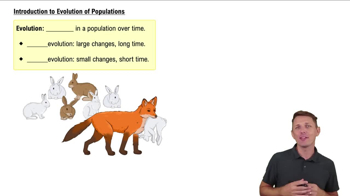
Introduction to Evolution of Populations
4733
views
89
rank
Termini in questo insieme (23)
Nascondere definizioni
What are the three major factors that alter allele frequencies and drive evolutionary change?
Natural selection
,
genetic drift
, and
gene flow
.
Define natural selection.
Differential reproductive success causes certain alleles to be passed on more frequently, leading to adaptive evolution.
What is the founder effect?
When a few individuals become isolated from a larger population, causing allele frequencies in the new population to differ from the original.
Describe the bottleneck effect.
A sudden reduction in population size due to environmental change, leading to a gene pool that may not represent the original population.
How does genetic drift affect small populations?
It causes random changes in allele frequencies, loss of genetic variation, and can fix harmful alleles by inbreeding.
What is gene flow?
The movement of alleles among populations through migration or gamete transfer, which can increase or decrease fitness.
Define relative fitness.
The contribution an individual makes to the gene pool of the next generation compared to others.
Name the three modes of natural selection.
Directional
,
disruptive
, and
stabilizing
selection.
What is directional selection?
Selection that favors individuals at one extreme of a phenotypic range.
What is disruptive selection?
Selection that favors individuals at both extremes of a phenotypic range.
What is stabilizing selection?
Selection that favors intermediate phenotypes and acts against extremes.
How does natural selection cause adaptive evolution?
By increasing the frequency of alleles that improve survival and reproduction in a changing environment.
What is sexual selection?
Natural selection for mating success, often causing sexual dimorphism.
Explain heterozygote advantage.
When heterozygous individuals have higher fitness than either homozygote, maintaining genetic variation.
What is frequency-dependent selection?
Selection where the fitness of a phenotype decreases if it becomes too common, favoring rarer phenotypes.
What is the biological species concept?
A species is a group of populations whose members can interbreed and produce viable, fertile offspring.
Define reproductive isolation.
Biological barriers that prevent two species from producing viable, fertile offspring.
Name two types of reproductive isolation barriers.
Prezygotic
(before fertilization) and
postzygotic
(after fertilization) barriers.
What is allopatric speciation?
Speciation that occurs when populations are geographically isolated, reducing gene flow.
What is sympatric speciation?
Speciation occurring within overlapping populations due to factors like polyploidy or sexual selection.
How can polyploidy lead to speciation?
By producing extra chromosome sets, creating new species especially in plants.
What is punctuated equilibrium?
A model where species experience long periods of stasis interrupted by sudden evolutionary change.
What limits natural selection from producing perfect organisms?
Selection acts only on existing variation, historical constraints, compromises in adaptations, and chance events.
 IndietroIndietro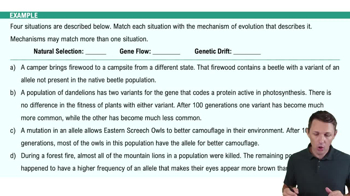
 03:33
03:33