 Indietro
Exam 1

 05:01

Termini in questo insieme (60)
Climate
long-term weather pattern in a region
Abiotic
nonliving, chemical & physical attributes to of an environment
Biotic
living organism that are a component to an ecosystem
Ecology
study of relationships between living organisms
Organism
an individual animal, plant, or single-celled life form
Population
individuals of one species inhabiting a specific geographic area
Community
groups of interacting species populations in a specific area/habitat
Landscape
an area containing several different ecosystems linked by exchanges of energy, materials, & organisms
Biosphere
entire portion of earth inhabited by life; sum of all the plant's ecosystems
Biome
any of the world's major ecosystem types
Climograph
visual graph that shows the yearly monthly averages for two main weather factors
Distrubance
a storm, fire, or human activity
Photic Zone
where light penetrates sufficiently for photosynthesis to occur
Aphotic Zone
beneath the photic zone, light does not penetrate for photosynthesis to occur
Limnetic
open water, close to shore of an ocean, lake, or river
Thermocline
abrupt temperature change in the ocean
Dispersal
movement of individuals or gametes away from their original location
Density
# of individuals per unit area or volume
Immigration
influx of individuals into a population from other area
Emmigration
leaving one's own habitat with the intent of moving to a different one
Interspecific interactions
a relationship between individuals of two or more species in a community
Competition
individuals of a different species competing for a resource
Competitive Exclusion
populations of two similar species compete for the same limited resources
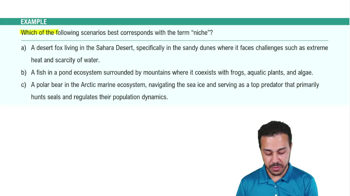
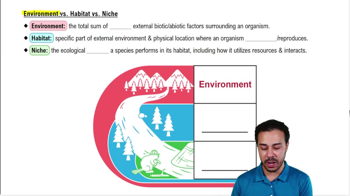
Ecological Niche
species' use of biotic and abiotic resources in its environment
Resource partitioning
division of environmental resources by coexisting species
Exploitation
when one species benefits by feeding on another species
Predation
one species, the predator, kills and eats an individuals of another species, the prey
Batesian mimicry
when a harmless species resembles a harmful species
Herbivory
when one species eats parts of plants/alga, harming usually but not killing it
Parasitism
when one organism, the parasite, lives on/inside another organism, the host, causing some harm
Mutualism
both species can survive alone
Commensalism
benefits one species without harming the other
Species diversity
number and relative abundance of species in a biological community
Species richness
# of species in a biological community
Relative abundance
proportional abundance of different species in a community
Biomass
total mass of organic matter comprising a group of organisms in a particular habitat
Introduced species
species moved by humans from its native location
Trophic Structure
feeding behaviors between organisms in a community
Food chain
links trophic levels from producers to top carnivores
Trophic level
position an organism occupies in a food chain
Food web
interconnected feeding relationships in an ecosystem
Foundation species
species that has strong effects on its community because of its large size
Keystone species
control by their ecological roles rather than abundance
Ecosystem engineers
an organism that influences community structure by causing physical changes in the environment
Disturbance
a storm, fire, or human activity
Ecological succession
sequential change in a community composition during colonization
Primary succession
restart after high level disturbance
Secondary succession
restart after intermediate level disturbance
Law of conservation of mass
matter can change form but cannot be created or destroyed
Primary producer
autotroph, a photosynthetic organism
Primary consumer
an herbivore; that eats plants or other autotrophs
Teritary consumer
carnivores, eat secondary consumers
Decomposer
an organism that absorbs nutrients from nonliving organic material like corpses, fallen plant material, and poop
Biogeochemical cycle
any of the various chemical cycles that involve biotic and abiotic components of ecosystems
Pathogens
an organism or virus that causes disease
Water cycle
main two are evaporation, and precipitation
What is happening between carbon hydrogen a d oxygen during cellular respiration
cellular respiration and photosynthesis
Phosph. Cycle
wethering of rocks is important since phosph. is stored in rocks
Explain how the sun's unequal heating of Earth's surface leads to the development of deserts around 30 degrees north and south of the equator
High temps evaporate water and cause warm, moist air to rise. The remaining dry air descends at 30 degrees north and south of, causing deserts.
Why are phytoplankton, and not benthic algae or rooted aquatic plants, the dominant photosynthetic organisms of the oceanic pelagic zone
There is too little light to support the benthic algae or rooted plants because they are located too far from where light penetrates which is needed to support photosynthesis.