 Indietro
Foundations of General Biology
 02:09


Termini in questo insieme (28)
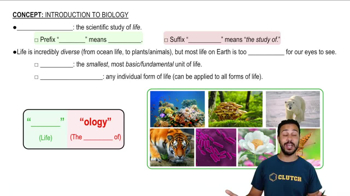
Biology is the study of life and living things, including subfields like molecular biology, ecology, genetics, biochemistry, and microbiology.
Maintain internal order, adapt and evolve, regulate responses, reproduce, respond to environment, grow and develop, process energy.
Emergent properties arise when individual parts interact to form a system with new functions, like photosynthesis in plants.
Reductionism isolates parts of a system to study them separately, like dissecting a car to understand its parts.
The systematic approach studies how components interact within a system, emphasizing that everything happens together.
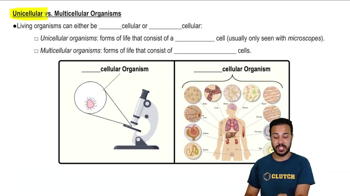
A cell is the smallest unit that performs all 7 essential life functions and has at least a cell membrane and genetic material.
Prokaryotic cells lack a nucleus; DNA floats in cytoplasm. Eukaryotic cells have a nucleus and membrane-bound organelles.
A gene is a specific chromosome region that acts as a blueprint for making proteins or molecules.
Nucleotides are the building blocks or letters of DNA strands.
DNA is transcribed into RNA (transcription), which is then translated into protein (translation).
Energy flows one way (solar), chemical matter is recycled and used to build structures; producers make chemical energy via photosynthesis.
Feedback loops regulate interactions: negative feedback stops a process; positive feedback amplifies it.
Species fit their environment, individuals vary in heritable traits, and competition for limited resources exists.
Better-suited individuals survive and reproduce more, accumulate in populations, causing unequal reproductive success.
Moving from specific observations to a general conclusion or hypothesis.
Starting with a general idea to make specific predictions.
An experiment comparing an experimental group receiving treatment to a control group without treatment.
Independent variable: what the researcher changes. Dependent variable: what is measured in response.
A testable explanation for an observation based on assumptions.
A well-supported explanation based on repeated testing and evidence.
A consistently observed natural relationship or pattern, like gravity.
An organism used to study biological processes representative of other systems, e.g., fruit flies.
Science develops knowledge; technology applies it for practical purposes, advancing each other.
Using computational tools to organize and analyze large biological datasets like DNA sequences.
Diverse backgrounds bring different perspectives, ideas, and approaches, improving problem-solving.
Qualitative data: descriptive, non-numerical. Quantitative data: numerical measurements or calculations.
Observation, reasoning, hypothesis, prediction, experiment, data collection, conclusion, reassessment, and repetition.
Coloring or patterns that help an organism blend into its environment to avoid detection.