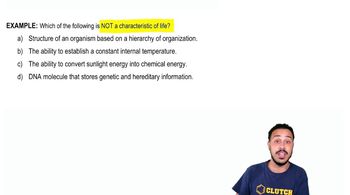
Life is membrane delimited, stores and transmits instructions, stores and uses energy, controls functions and responds to the environment, is self-replicating, and is evolving.
What is the smallest unit of life?
The cell is the smallest unit of life that meets all fundamental properties of life.
How is biology defined scientifically?
Biology is the scientific study of life, using the scientific method to understand living systems.
What is the scientific method?
A process involving observation, hypothesis, prediction, experiment with control, and conclusion to test scientific questions.
What is the role of a control group in an experiment?
A control group does not receive the experimental treatment and serves as a baseline to compare effects of the variable.
What biomolecules facilitate the properties of life?
The main biomolecules are lipids, carbohydrates, nucleic acids, and proteins, each supporting different life functions.
What is the role of lipids in cells?
Lipids form membranes that provide compartmentation and selective permeability, and can also store energy and provide insulation.
How do nucleic acids support life?
Nucleic acids store and transmit genetic information essential for replication and function.
What is the function of proteins in living organisms?
Proteins control cellular functions and enable responses to the environment.
How is energy stored and used in cells?
Energy is stored in chemical bonds of molecules and converted into ATP, which cells use to perform work.
What distinguishes prokaryotic cells from eukaryotic cells?
Prokaryotes lack a nucleus and membrane-bound organelles, have circular DNA, and are smaller; eukaryotes have a nucleus, linear DNA, and membrane-bound organelles.
What is the definition of life according to NASA's adopted definition?
Life is a self-sustained chemical system capable of undergoing Darwinian evolution.
What is the importance of membranes in life?
Membranes provide a selectively permeable barrier that separates the cell from its environment and allows controlled exchange.
What is the significance of self-replication in life?
Self-replication allows organisms to reproduce and pass genetic information to offspring, enabling evolution.
How does evolution relate to life?
Evolution is the change in heritable characteristics of populations over generations, a fundamental property of life.
What is the role of carbohydrates in cells?
Carbohydrates serve as energy sources and structural components in cells.
What is the difference between independent and dependent variables in an experiment?
The independent variable is the factor tested or changed; the dependent variable is the measured response or effect.
Why is it important to test yourself and use active recall in studying biology?
Active recall helps retain information better by forcing you to retrieve knowledge, improving long-term memory.
What is the role of ATP in cellular energy?
ATP stores and provides energy for cellular processes by releasing energy when its phosphate bonds are broken.
What are the main types of cells in biology?
The two main types are prokaryotic cells (bacteria and archaea) and eukaryotic cells (plants, animals, fungi, protozoa).
 Indietro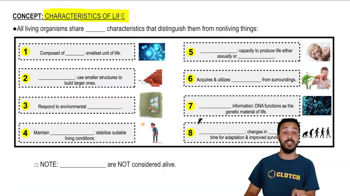
 09:26
09:26