 Indietro
Fundamentals of Biology - Properties of Life and Cell Types
 09:26
09:26
Termini in questo insieme (20)
Life is a self-sustained chemical system capable of undergoing Darwinian evolution.
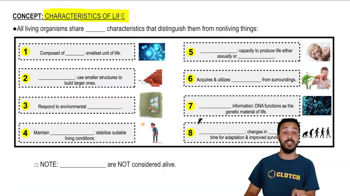
Life is membrane delimited, made of cells, stores and follows instructions, stores and uses energy, is self-replicating, controls functions and responds to the environment, and evolves.
Lipids provide membranes that are selectively permeable, enabling compartmentation, energy storage, and insulation.
Nucleic acids store and transmit genetic information essential for life.
Proteins control cellular functions and enable responses to the environment.
Life stores and uses energy, often converting it into ATP, which cells use to perform work.
The cell is the smallest unit that meets all properties of life.
Prokaryotes have no nucleus, circular DNA, small size (0.1-5 microns), lack membrane-bound organelles, and replicate quickly.
Eukaryotes have a nucleus, linear DNA organized in chromosomes, membrane-bound organelles, and are larger (1-100 microns).
Viruses store and follow instructions, use energy, replicate (with host), respond to environment, and evolve, but lack membranes and independent energy storage.
Life's properties are supported by four main biomolecules: lipids, carbohydrates, nucleic acids, and proteins.
Evolution is the change in heritable characteristics of biological populations over generations.
Life is membrane delimited, meaning cells have membranes that separate internal from external environments.
Life is self-replicating, meaning it can produce copies of itself using biomolecules.
Life stores and transmits information primarily through DNA and RNA.
Life transforms energy from sunlight or organic compounds into usable cellular energy like ATP.
Life controls its functions and responds to environmental changes mainly through proteins.
Lipids form membranes, carbohydrates provide energy, nucleic acids store information, and proteins perform cellular functions.
Prokaryotic cells are smaller (0.1-5 microns) than eukaryotic cells (1-100 microns).
Prokaryotes have circular DNA; eukaryotes have linear DNA organized into chromosomes.