Fungi are heterotrophs that absorb nutrients from outside their bodies by secreting enzymes to break down complex molecules.
What is the main structural component of fungal cell walls?
Fungal cell walls contain chitin, a strong, flexible polysaccharide.
Describe the typical body structure of multicellular fungi.
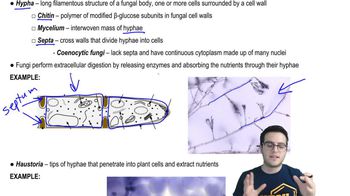
Multicellular fungi consist of mycelia, networks of branched hyphae that maximize surface area for nutrient absorption.
What are septate and coenocytic hyphae?
Septate hyphae have cross-walls (septa) with pores for organelle movement; coenocytic hyphae lack septa and contain many nuclei in a continuous cytoplasm.
What specialized hyphae do arbuscular mycorrhizal fungi have and what is their function?
They have arbuscules that penetrate plant root cells to exchange nutrients, delivering phosphate to plants in exchange for carbohydrates.
Outline the general fungal life cycle stages.
Fungi propagate by spores, have haploid nuclei, undergo plasmogamy (cytoplasm fusion), form heterokaryotic stages, then karyogamy (nuclei fusion) followed by meiosis to produce spores.
What is plasmogamy in fungi?
Plasmogamy is the fusion of cytoplasm from two parent mycelia, leading to a heterokaryotic stage with separate haploid nuclei.
What is karyogamy and its significance in fungi?
Karyogamy is the fusion of haploid nuclei to form a diploid zygote, which is short-lived and followed by meiosis to generate genetic variation.
How do molds and yeasts differ in reproduction?
Molds produce haploid spores asexually by mitosis forming mycelia; yeasts reproduce asexually by simple cell division or budding without spores.
What is the evolutionary relationship between fungi and animals?
Fungi and animals share a common unicellular, flagellated ancestor and belong to the Opisthokonts clade, but multicellularity evolved independently in each.
Name the major fungal groups based on molecular phylogenies.
Major groups include Cryptomycetes, Microsporidians, Chytrids, Zoopagomycetes, Mucoromycetes, Ascomycetes, and Basidiomycetes.
What unique feature distinguishes chytrids from other fungi?
Chytrids have flagellated spores called zoospores, unique among higher fungi.
What are the ecological roles of fungi?
Fungi act as decomposers, parasites, and mutualists, recycling nutrients and forming symbiotic relationships.
What is a lichen?
A lichen is a mutualistic symbiosis between a fungus (usually an ascomycete) and a photosynthetic partner like green algae or cyanobacteria.
What percentage of fungal species are parasites or pathogens?
About 30% of known fungal species are parasites or pathogens, mostly affecting plants.
What is mycosis?
Mycosis is a fungal infection in animals, including humans, sometimes opportunistic like Candida albicans infections.
List some human uses of fungi.
Humans consume fungi as food, use them in fermentation (e.g., brewer's yeast), produce antibiotics (e.g., Penicillium), and employ them in genetic research.
How do fungi contribute to nutrient cycling?
Fungi efficiently decompose organic materials like cellulose and lignin, recycling chemical elements between living and nonliving components.
What is the significance of fungal mycelium's surface-to-volume ratio?
The high surface-to-volume ratio of mycelium enhances nutrient absorption efficiency.
How do fungi disperse through the environment?
Fungi disperse via haploid spores produced sexually or asexually, which can travel through air, water, or other vectors.
 Indietro

 08:59