Skip to main content
General Biology
Il mio corso
Impara
Preparazione agli esami
AI Tutor
Guide di studio
Soluzioni per libri di testo
Flashcard
Esplora
Prova l'app
Il mio corso
Impara
Preparazione agli esami
AI Tutor
Guide di studio
Soluzioni per libri di testo
Flashcard
Esplora
Prova l'app
Indietro
Gene Expression and Regulation - General Biology
Puoi toccare per girare la carta.
What is the flow of genetic information in cells?
Puoi toccare per girare la carta.
👆
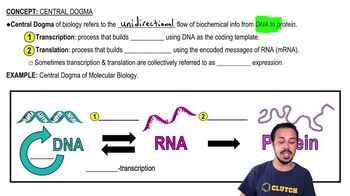
What is the flow of genetic information in cells?
Genetic information flows in a one-way direction known as the
Central Dogma
: DNA > RNA > Protein.
Avanzamenti del tracciato
I pulsanti di controllo sono stati cambiati in modalità "navigazione".
1/28
Video consigliati
05:45
Central Dogma
22180
views
312
rank
3
comments
Termini in questo insieme (28)
Nascondere definizioni
What is the flow of genetic information in cells?
Genetic information flows in a one-way direction known as the
Central Dogma
: DNA > RNA > Protein.
What molecule serves as the permanent hereditary blueprint in cells?
DNA
is the permanent hereditary molecule that stores genetic information.
What molecule acts as the cell's 'molecular workers' performing physical tasks?
Proteins
are the cell's molecular workers that perform physical labor.
What is the main difference between DNA and RNA strands?
DNA
is double-stranded, while
RNA
is single-stranded.
What sugar is found in RNA but not in DNA?
Ribose
sugar is found in RNA, whereas DNA contains deoxyribose.
Which nitrogenous base is unique to RNA replacing thymine in DNA?
Uracil
replaces thymine in RNA.
Why can RNA leave the nucleus while DNA cannot?
RNA's
single-stranded
nature and smaller size allow it to exit the nucleus.
What is transcription?
Transcription is the process of copying a gene's DNA sequence into an RNA strand.
Where does transcription occur and which enzyme drives it?
Transcription occurs in the
nucleus
and is driven by
RNA polymerase
.
What is the role of the promoter in transcription?
The
promoter
is a DNA sequence where RNA polymerase binds to start transcription.
What modifications occur to pre-mRNA before it becomes mature mRNA?
A
5' cap
and
poly-A tail
are added, introns are removed, and exons are spliced together.
What is translation?
Translation is decoding mRNA into a sequence of amino acids to build a protein.
Where does translation take place in the cell?
Translation occurs in the
cytoplasm
at the
ribosome
.
What are the two subunits of a ribosome responsible for?
The
small subunit
binds mRNA; the
large subunit
binds tRNA and catalyzes peptide bonds.
What signals the start and end of translation?
Translation starts at the
start codon (AUG)
and ends at one of three
stop codons (UAA, UAG, UGA)
.
What is the role of mRNA in protein synthesis?
mRNA
carries the genetic code from the nucleus to the ribosome.
What is the function of tRNA during translation?
tRNA
delivers specific amino acids to the ribosome and has an anticodon complementary to mRNA codons.
What does rRNA do in the cell?
rRNA
combines with proteins to form ribosomal subunits and catalyzes protein synthesis.
What is a codon?
A
codon
is a sequence of three mRNA nucleotides that specifies an amino acid or a start/stop signal.
What is an anticodon?
An
anticodon
is a sequence of three bases in tRNA complementary to an mRNA codon.
How many nucleotides make up one codon?
One codon consists of
three nucleotides
.
What is the significance of the redundancy in the genetic code?
Redundancy means multiple codons can code for the same amino acid, reducing the impact of some mutations.
What is the difference between exons and introns?
Exons
are coding sequences kept in mRNA;
introns
are noncoding sequences removed during RNA processing.
What is the main goal of transcription versus translation?
Transcription copies DNA into RNA; translation decodes RNA into a protein.
What is the starting signal for transcription?
The
promoter
region, often containing the TATAAA sequence, signals transcription start.
What are the three stop codons in translation?
The stop codons are
UAA
,
UAG
, and
UGA
.
What enzyme synthesizes RNA from a DNA template?
RNA polymerase
synthesizes RNA during transcription.
What is the template strand in transcription?
The
template strand
is the DNA strand used by RNA polymerase to make complementary RNA.
 IndietroIndietro
 05:45
