Skip to main content
General Biology
Il mio corso
Impara
Preparazione agli esami
AI Tutor
Guide di studio
Soluzioni per libri di testo
Flashcard
Esplora
Prova l'app
Il mio corso
Impara
Preparazione agli esami
AI Tutor
Guide di studio
Soluzioni per libri di testo
Flashcard
Esplora
Prova l'app
Indietro
Gene Regulation in General Biology
Puoi toccare per girare la carta.
What does 'gene expression' refer to?
Puoi toccare per girare la carta.
👆
What does 'gene expression' refer to?
The entire process from transcription to translation of a functional protein, not just transcription.
Avanzamenti del tracciato
I pulsanti di controllo sono stati cambiati in modalità "navigazione".
1/25
Video consigliati
02:17
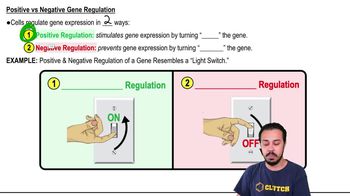
Positive vs Negative Gene Regulation
10490
views
96
rank
2
comments
06:40
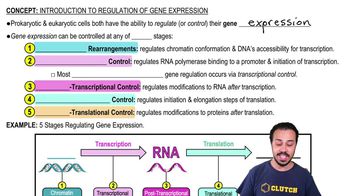
Introduction to Regulation of Gene Expression
12917
views
165
rank
1
comments
Termini in questo insieme (25)
Nascondere definizioni
What does 'gene expression' refer to?
The entire process from transcription to translation of a functional protein, not just transcription.
Why do genetically identical somatic cells have different shapes and functions?
Because of differential gene expression regulated by transcription factors.
What is an operon in bacteria?
A cluster of genes under control of a single promoter and operator, regulated together.
What is the role of the operator in an operon?
It is the DNA segment where repressor proteins bind to turn transcription off; when unbound, transcription is on.
What advantage does an operon provide by controlling multiple genes?
It allows coordinated regulation of genes with related functions, saving energy and resources.
Name key components regulating transcription in prokaryotes.
Operon, promoter, operator, multiple genes, repressor protein, activator protein, corepressor, RNA polymerase.
What molecules regulate the lac operon?
Lactose, allolactose (inducer), glucose, cAMP, CAP (activator), repressor protein.
How does the trp operon regulate gene expression?
Tryptophan acts as a corepressor that binds the repressor to turn transcription off when tryptophan is abundant.
How is transcription initiation regulated in eukaryotes?
By transcription factors, RNA polymerase, promoter, and the transcription initiation complex.
What is the transcription initiation complex?
A protein assembly including transcription factors and RNA polymerase needed to start transcription.
What role do activator proteins play in eukaryotic transcription?
They bind to enhancers and help assemble the transcription initiation complex to start transcription.
What is epigenetic inheritance?
Heritable changes in gene expression without changes in DNA sequence, often via histone acetylation or DNA methylation.
How does histone acetylation affect gene expression?
It loosens chromatin structure, making DNA more accessible and increasing gene expression.
How does DNA methylation affect gene expression?
It tightens chromatin and typically represses gene expression.
What happens to gene expression when no transcription factors bind the promoter?
Gene expression is turned off because RNA polymerase cannot initiate transcription.
What is alternative splicing?
A process where different exons are joined to produce multiple protein variants from one gene.
How does alternative splicing increase protein diversity?
By allowing one gene to code for multiple proteins through different mRNA variants.
What determines the lifespan of an mRNA molecule?
Features like the untranslated regions (UTRs) and the poly A tail influence mRNA stability.
What portion of the human genome codes for proteins?
Only a small fraction of the genome codes for proteins.
What proportion of the genome is transcribed but not translated?
A large portion is transcribed into noncoding RNAs that regulate gene expression.
How do microRNAs (miRNAs) regulate gene expression?
They bind to mRNA to block translation or promote degradation, reducing protein production.
What is cell differentiation?
The process by which cells become specialized in structure and function.
How do cytoplasmic determinants influence cell differentiation?
Maternal RNAs and proteins unevenly distributed in the egg cytoplasm affect gene expression in daughter cells.
What is induction in embryonic development?
Signaling molecules from one group of cells influence gene expression in neighboring cells to guide differentiation.
What causes cancer in terms of gene regulation?
Genetic changes that disrupt normal cell cycle control lead to unregulated cell division.
 IndietroIndietro
 02:17