The cell is the simplest collection of matter that can be alive and is the basic building block of all organisms.
Difference between light and electron microscopes
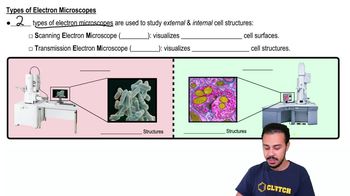
Light microscopes use visible light and can distinguish cells but not organelles; electron microscopes use electron beams and can see smaller structures like organelles.
What is cell fractionation?
A technique that separates cell components by spinning disrupted cells in a centrifuge, isolating organelles based on size and density.
Key differences between prokaryotic and eukaryotic cells
Prokaryotes lack a nucleus and membrane-bound organelles; eukaryotes have a nucleus and membrane-bound organelles.
What limits cell size?
The surface area to volume ratio limits cell size because volume increases faster than surface area, affecting diffusion efficiency.
Function of the nucleus
The nucleus houses most of the cell's genes and is enclosed by a double membrane called the nuclear envelope with pores for molecular traffic.
What are chromosomes?
Chromosomes are discrete units of DNA and protein (chromatin) found in the nucleus, condensing into X shapes during cell division.
Role of the nucleolus
The nucleolus synthesizes ribosomal RNA (rRNA), which forms ribosomes.
Components of the endomembrane system
Includes the nuclear envelope, endoplasmic reticulum, Golgi apparatus, lysosomes, vesicles, vacuoles, and plasma membrane.
Difference between rough and smooth ER
Rough ER has ribosomes and synthesizes proteins; smooth ER lacks ribosomes and is involved in lipid synthesis, detoxification, and calcium storage.
Function of ribosomes
Ribosomes synthesize proteins; free ribosomes make cytosolic proteins, bound ribosomes make proteins for membranes or export.
Role of the Golgi apparatus
Modifies, sorts, and ships proteins received from the ER; has a cis face (receiving) and trans face (shipping).
What are lysosomes?
Membrane-bound sacs with enzymes that digest macromolecules and recycle damaged organelles via autophagy.
Functions of vacuoles
Large vesicles for storage, waste disposal, water balance (contractile vacuoles), and growth (central vacuole in plants).
What are peroxisomes?
Organelles that transfer hydrogen to oxygen, producing hydrogen peroxide, which is then broken down by catalase.
Mitochondria function and structure
Generate ATP through cellular respiration; have a double membrane with inner folds called cristae and a matrix inside.
Chloroplast function and structure
Site of photosynthesis in plants; contain thylakoids stacked into grana within the stroma.
What is the endosymbiont theory?
Theory that mitochondria and chloroplasts originated from engulfed prokaryotic cells that became symbiotic within early eukaryotes.
Components of the cytoskeleton
Microtubules, microfilaments (actin filaments), and intermediate filaments provide support, shape, and movement.
Role of motor proteins
Interact with the cytoskeleton to produce movement, such as cilia and flagella beating or muscle contraction.
Structure and function of microtubules
Hollow rods made of tubulin dimers; provide cell shape, support, and tracks for organelle movement.
What are centrosomes and centrioles?
Centrosomes organize microtubules in animal cells; centrioles within centrosomes help form spindle fibers during cell division.
Structure of cilia and flagella
Have a 9 + 2 arrangement of microtubule doublets around a central pair, anchored by a basal body.
How do cilia and flagella move?
Dynein motor proteins 'walk' along microtubules, causing bending powered by ATP.
Microfilaments and their role in motility
Made of actin, they support cell shape and enable movement like muscle contraction and cell crawling.
Function of intermediate filaments
Provide mechanical strength and maintain organelle position; more permanent than other cytoskeletal fibers.
Functions of the plant cell wall
Protects, maintains shape, prevents excess water uptake, and supports the plant; made of cellulose microfibrils.
What is the extracellular matrix (ECM)?
A network outside animal cells made of glycoproteins like collagen; supports adhesion, movement, and signaling.
Types of intercellular junctions in animal cells
Tight junctions (seal cells), desmosomes (anchor cells), and gap junctions (channels for communication).
 Indietro
 06:35