Skip to main content
General Biology
Il mio corso
Impara
Preparazione agli esami
AI Tutor
Guide di studio
Soluzioni per libri di testo
Flashcard
Esplora
Prova l'app
Il mio corso
Impara
Preparazione agli esami
AI Tutor
Guide di studio
Soluzioni per libri di testo
Flashcard
Esplora
Prova l'app
Indietro
General Biology: A Tour of the Cell
Puoi toccare per girare la carta.
Why must cells be small?
Puoi toccare per girare la carta.
👆
Why must cells be small?
Cells must be small to maintain a high surface-to-volume ratio, which is necessary for efficient transport of nutrients and wastes.
Avanzamenti del tracciato
I pulsanti di controllo sono stati cambiati in modalità "navigazione".
1/23
Video consigliati
04:26
Recap: Prokaryotic vs. Eukaryotic Cells
23427
views
409
rank
05:54
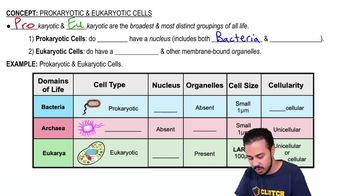
Prokaryotic & Eukaryotic Cells
39176
views
863
rank
4
comments
03:54
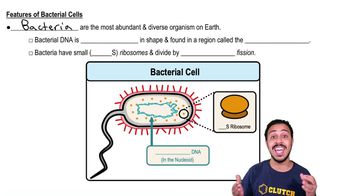
Features of Bacterial Cells
28376
views
508
rank
1
comments
Termini in questo insieme (23)
Nascondere definizioni
Why must cells be small?
Cells must be small to maintain a high surface-to-volume ratio, which is necessary for efficient transport of nutrients and wastes.
What are the two main categories of cells?
The two main categories are
Prokaryotes
and
Eukaryotes
.
What is the endosymbiotic theory?
It proposes that eukaryotic cells evolved from simple cells that incorporated other cells, which became organelles like mitochondria and chloroplasts.
Name three common prokaryotic cell shapes.
Bacilli
(rod-shaped),
Spiral
, and
Cocci
(spherical).
What is the function of the prokaryotic cell capsule or slime layer?
It protects the cell from environmental threats and helps in attachment to surfaces.
What is the composition and function of the prokaryotic cell wall?
Made of
peptidoglycan
, it provides structure and protection.
What are flagella, fimbriae, and conjugation pili in prokaryotes?
Flagella
provide motility,
fimbriae
help attachment, and
conjugation pili
allow genetic material exchange.
What are inclusions in prokaryotic cells?
Stored granules of substances needed by the cell.
What is the function of ribosomes?
Ribosomes synthesize proteins.
What are the components of the cytoskeleton?
Microfilaments, intermediate filaments, and microtubules.
What is the role of microfilaments?
They provide structural support, form microvilli, and aid cytoplasmic streaming.
What are microtubules made of and their functions?
Made of
tubulin
, they form cilia, flagella, mitotic spindle, and serve as tracks for intracellular transport.
Describe the structure and function of flagella in eukaryotic cells.
Flagella have a 9+2 microtubule structure, anchored by a basal body, and move the cell with whip-like motions.
What is the centrosome and its role?
The centrosome organizes microtubules and creates the mitotic spindle during cell division.
Differentiate between rough ER and smooth ER.
Rough ER has ribosomes and synthesizes proteins; smooth ER lacks ribosomes and synthesizes lipids and detoxifies.
What is the function of the Golgi complex?
It modifies, sorts, and packages proteins and lipids for transport.
What is the role of lysosomes?
Lysosomes contain hydrolytic enzymes that digest macromolecules and cellular debris.
Describe the mitochondrion's function and structure.
Mitochondria generate ATP through cellular respiration and have a double membrane with inner folds called cristae.
What is the function of chloroplasts?
Chloroplasts conduct photosynthesis, converting solar energy into chemical energy.
What are peroxisomes responsible for?
Peroxisomes digest lipids and detoxify harmful substances.
What is stored in vacuoles and where are they commonly found?
Vacuoles store substances like starch or water and are found in plants and some protists.
What are the key features of the eukaryotic nucleus?
It contains DNA, has a double phospholipid bilayer membrane, nucleolus for ribosome synthesis, and nuclear pores for transport.
Outline the process of hydrolytic enzyme formation in the cell.
1) RER synthesizes enzymes; 2) enzymes transported to Golgi in vesicles; 3) Golgi modifies and packages enzymes; 4) enzymes released in lysosomes.
 IndietroIndietro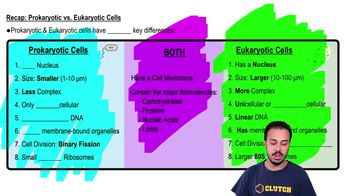
 04:26
04:26