What is the basic unit of structure and function in all organisms?
The cell is the simplest collection of matter that can live and is the basic unit of structure and function in all organisms.
What is magnification in microscopy?
Magnification is the ratio of an object’s image size to its real size.
What limits the resolution of a microscope?
Resolution is limited by the shortest wavelength of the radiation used for imaging.
What is the practical resolution limit of an electron microscope (EM)?
The practical resolution limit of an EM is about 2 nanometers (nm).
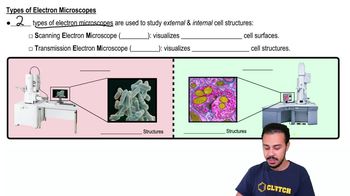
What is the difference between transmission electron microscopes (TEMs) and scanning electron microscopes (SEMs)?
TEMs study internal cell ultrastructure by aiming electrons through thin sections; SEMs study surface structures by scanning the surface coated with gold.
What is the goal of cell fractionation?
To separate major organelles of cells so their individual functions can be studied.
What major difference distinguishes prokaryotic and eukaryotic cells?
Eukaryotic cells have a membrane-enclosed nucleus containing chromosomes; prokaryotic cells have DNA concentrated in a nucleoid without a membrane.
Why are most cells microscopic in size?
Because as cell size increases, volume grows faster than surface area, limiting exchange of materials across the plasma membrane.
What is the function of microvilli in cells?
Microvilli are long, thin projections that increase surface area for material exchange without significantly increasing cell volume.
What is the general structure of biological membranes?
A double layer of phospholipids with embedded and attached proteins, each membrane having a unique lipid and protein composition.
What is the function of the nucleus in eukaryotic cells?
The nucleus houses most of the cell’s genes and directs protein synthesis by producing messenger RNA (mRNA).
What are ribosomes and their two types?
Ribosomes are organelles that synthesize proteins; free ribosomes float in cytosol, and bound ribosomes are attached to the ER or nuclear envelope.
What are the two regions of the endoplasmic reticulum (ER) and their functions?
The rough ER has ribosomes and synthesizes proteins; the smooth ER lacks ribosomes and synthesizes lipids, detoxifies drugs, and stores calcium ions.
What is the role of the Golgi apparatus?
The Golgi apparatus modifies, sorts, and packages proteins and lipids received from the ER for storage or transport.
What are lysosomes and their function?
Lysosomes are membrane-bound sacs of hydrolytic enzymes that digest macromolecules and recycle cellular components.
What is autophagy?
Autophagy is the process where lysosomes digest damaged organelles or cytosol to recycle their components.
What are mitochondria and their main function?
Mitochondria are organelles that generate ATP through cellular respiration by catabolizing sugars, fats, and other fuels.
What are chloroplasts and their main function?
Chloroplasts are plant and algal organelles that perform photosynthesis, converting solar energy into chemical energy.
What is the cytoskeleton and its main roles?
The cytoskeleton is a network of fibers that provides mechanical support, maintains cell shape, enables motility, and regulates cellular activities.
What are the three main types of cytoskeletal fibers?
 Indietro
 06:35