Skip to main content
General Biology
Il mio corso
Impara
Preparazione agli esami
AI Tutor
Guide di studio
Soluzioni per libri di testo
Flashcard
Esplora
Prova l'app
Il mio corso
Impara
Preparazione agli esami
AI Tutor
Guide di studio
Soluzioni per libri di testo
Flashcard
Esplora
Prova l'app
Indietro
General Biology: A Tour of the Cell
Puoi toccare per girare la carta.
What are the two major categories of cells?
Puoi toccare per girare la carta.
👆
What are the two major categories of cells?
Prokaryotic cells
(smaller, simpler, no nucleus) and
eukaryotic cells
(larger, complex, nucleus enclosed by membrane).
Avanzamenti del tracciato
I pulsanti di controllo sono stati cambiati in modalità "navigazione".
1/20
Video consigliati
06:35
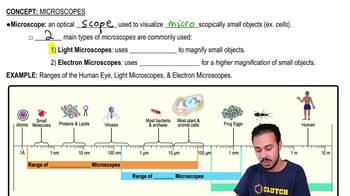
Microscopes
24803
views
566
rank
02:52
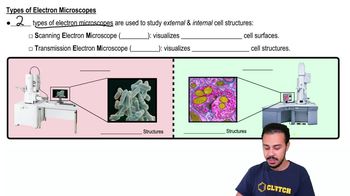
Types of Electron Microscopes
17799
views
355
rank
1
comments
Termini in questo insieme (20)
Nascondere definizioni
What are the two major categories of cells?
Prokaryotic cells
(smaller, simpler, no nucleus) and
eukaryotic cells
(larger, complex, nucleus enclosed by membrane).
What is the function of the plasma membrane?
The
plasma membrane
separates the living cell from its nonliving surroundings and is composed mainly of phospholipids and proteins.
Describe the fluid mosaic model of the membrane.
Membrane phospholipids and proteins can drift about in the plane of the membrane, creating a
fluid mosaic
structure.
What is the role of the extracellular matrix in animal cells?
The
extracellular matrix
helps protect and support cells and facilitates interactions between neighboring cells in tissues.
What is the nucleus and what does it contain?
The
nucleus
is the cell's manager, containing chromatin, the nucleolus, and is surrounded by a double membrane called the nuclear envelope.
How does DNA control the cell?
DNA transfers coded information into RNA, which is then used to make proteins.
What are the two types of endoplasmic reticulum (ER) and their functions?
Rough ER
has ribosomes and produces membrane proteins and new membrane;
Smooth ER
lacks ribosomes and produces lipids including steroids.
What is the function of the Golgi apparatus?
The Golgi apparatus refines, stores, and distributes chemical products of the cell, working closely with the ER.
What are lysosomes and their function?
Lysosomes are membrane-enclosed sacs containing digestive enzymes that break down macromolecules.
What are vacuoles and their types?
Vacuoles are membranous sacs; types include contractile vacuoles in protists and central vacuoles in plants.
What are peroxisomes and their role?
Peroxisomes are metabolic compartments that produce hydrogen peroxide and convert it to water, breaking down molecules using oxygen.
What is the function of chloroplasts?
Chloroplasts are the sites of photosynthesis, converting light energy into chemical energy in plant cells.
What is the role of mitochondria?
Mitochondria are the sites of cellular respiration, producing ATP from food molecules.
What unique feature do mitochondria and chloroplasts share?
They contain their own DNA, supporting the theory they evolved from free-living prokaryotes.
What is the cytoskeleton and its functions?
The cytoskeleton is a network of fibers providing mechanical support, maintaining cell shape, and enabling cell movement.
How do cilia and flagella differ in movement?
Flagella move in a whiplike motion to propel cells; cilia move in a coordinated back-and-forth motion.
What are intercellular junctions?
Structures that connect cells, facilitating communication and adhesion between neighboring cells.
What is the significance of ribosomes in the cell?
Ribosomes synthesize proteins by translating mRNA into polypeptide chains.
What is the role of the nucleolus?
The nucleolus is the site within the nucleus where ribosomal RNA is synthesized and ribosome assembly begins.
How do prokaryotic and eukaryotic cells differ in organelle presence?
Prokaryotic cells lack most organelles and have DNA concentrated in a nucleoid region; eukaryotic cells have many membrane-bound organelles.
 IndietroIndietro
 06:35