Skip to main content
General Biology
Il mio corso
Impara
Preparazione agli esami
AI Tutor
Guide di studio
Soluzioni per libri di testo
Flashcard
Esplora
Prova l'app
Il mio corso
Impara
Preparazione agli esami
AI Tutor
Guide di studio
Soluzioni per libri di testo
Flashcard
Esplora
Prova l'app
Indietro
General Biology: A Tour of the Cell
Puoi toccare per girare la carta.
What are the three important parameters of microscopy?
Puoi toccare per girare la carta.
👆
What are the three important parameters of microscopy?
Magnification
: ratio of image size to real size;
Resolution
: clarity or minimum distance between points;
Contrast
: visible brightness differences.
Avanzamenti del tracciato
I pulsanti di controllo sono stati cambiati in modalità "navigazione".
1/20
Video consigliati
06:35
Microscopes
24139
views
558
rank
02:52
Types of Electron Microscopes
17287
views
350
rank
1
comments
Termini in questo insieme (20)
Nascondere definizioni
What are the three important parameters of microscopy?
Magnification
: ratio of image size to real size;
Resolution
: clarity or minimum distance between points;
Contrast
: visible brightness differences.
What is the main limitation of light microscopes?
Light microscopes cannot resolve internal cell anatomy well, especially organelles.
How do electron microscopes (EM) improve resolution compared to light microscopes?
EMs use electron beams with shorter wavelengths, achieving resolution down to ~2 nm, much finer than light microscopes.
What is the difference between scanning electron microscopes (SEM) and transmission electron microscopes (TEM)?
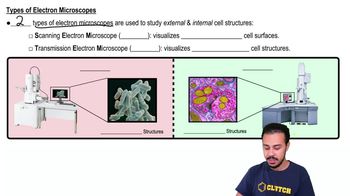
SEM studies surface structures; TEM studies internal cell structures using thin stained sections.
What is a key advantage of light microscopy over electron microscopy?
Light microscopy can be used to observe live cells and dynamic processes.
What are the two main types of cells?
Prokaryotic
(Bacteria and Archaea) and
Eukaryotic
(Protists, fungi, animals, plants).
What is the key difference between prokaryotic and eukaryotic cells?
Eukaryotic DNA is enclosed in a nucleus; prokaryotic DNA is in a nucleoid without a membrane.
What is the plasma membrane composed of?
A double layer of phospholipids with embedded proteins and carbohydrates.
What is the function of the plasma membrane?
Acts as a selective barrier regulating exchange of oxygen, nutrients, and waste.
What is the nucleus and its main function?
An organelle containing most DNA; controls gene expression and DNA replication.
What is the nuclear envelope?
A double membrane enclosing the nucleus with pores regulating exchange with cytoplasm.
What is the nuclear lamina?
A protein filament network lining the nuclear envelope, maintaining nuclear shape.
What is chromatin?
The uncondensed DNA-protein complex in the nucleus.
What is the nucleolus and its function?
A dense region in the nucleus that synthesizes rRNA and assembles ribosomal subunits.
How do ribosomes function in protein synthesis?
Ribosomes read mRNA and translate genetic code into polypeptides (proteins).
What are the two types of ribosomes?
Free ribosomes in cytosol synthesize proteins for cytosol; bound ribosomes on ER synthesize proteins for membranes or export.
What is the cytoplasm in eukaryotic cells?
The region between the nucleus and plasma membrane containing organelles.
Why are eukaryotic cells generally larger than prokaryotic cells?
Eukaryotes have membrane-bound organelles and more complex internal structures.
What is the role of membrane proteins?
They assist in transport, enzymatic activity, signal transduction, and cell recognition.
What is the function of mitochondria?
Organelles that generate ATP through cellular respiration.
 IndietroIndietro
 06:35
06:35