Skip to main content
General Biology
Il mio corso
Impara
Preparazione agli esami
AI Tutor
Guide di studio
Soluzioni per libri di testo
Flashcard
Esplora
Prova l'app
Il mio corso
Impara
Preparazione agli esami
AI Tutor
Guide di studio
Soluzioni per libri di testo
Flashcard
Esplora
Prova l'app
Indietro
General Biology: Atoms, Molecules, and Chemical Bonds
Puoi toccare per girare la carta.
What determines the chemical reactivity of an atom?
Puoi toccare per girare la carta.
👆
What determines the chemical reactivity of an atom?
The electrons in the outermost or
valence shell
determine an atom's chemical reactivity.
Avanzamenti del tracciato
I pulsanti di controllo sono stati cambiati in modalità "navigazione".
1/20
Video consigliati
04:26
Recap: Prokaryotic vs. Eukaryotic Cells
23405
views
408
rank
05:54
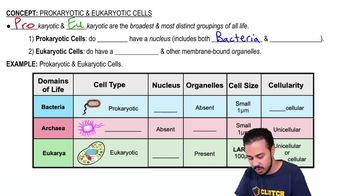
Prokaryotic & Eukaryotic Cells
39143
views
863
rank
4
comments
03:54
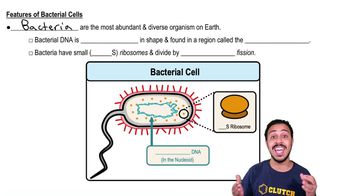
Features of Bacterial Cells
28344
views
507
rank
1
comments
Termini in questo insieme (20)
Nascondere definizioni
What determines the chemical reactivity of an atom?
The electrons in the outermost or
valence shell
determine an atom's chemical reactivity.
What is the maximum number of electrons in the first three electron shells?
Shell 1 holds up to 2 electrons, Shell 2 up to 8 electrons, and Shell 3 up to 8 electrons.
What makes an atom stable?
An atom is stable when its valence shell is
full
: 2 electrons in shell 1, 8 in shell 2, and 8 in shell 3.
What defines an element?
The
atomic number
, which is the number of protons in the nucleus, defines an element.
What is the relationship between protons and electrons in a neutral atom?
In a neutral atom, the number of protons equals the number of electrons.
What is the octet rule?
Atoms tend to gain, lose, or share electrons to have 8 electrons in their valence shell, achieving stability.
How do atoms with incomplete outer shells achieve stability?
They interact by sharing, donating, or receiving electrons, forming
chemical bonds
.
What are the two main types of chemical bonds?
Ionic bonds (transfer of electrons) and covalent bonds (sharing of electrons).
What is an ionic bond?
A bond formed by the attraction between oppositely charged ions after electron transfer.
What is a covalent bond?
A bond formed by the sharing of valence electrons between atoms.
What is the difference between polar and nonpolar covalent bonds?
Polar covalent bonds have unequal sharing of electrons causing partial charges; nonpolar bonds share electrons equally.
What is electronegativity?
The ability of an atom to attract shared electrons in a covalent bond.
Which atoms are highly electronegative?
Oxygen and Nitrogen are highly electronegative atoms.
How is polarity indicated in polar covalent bonds?
Partial positive and negative charges are denoted by δ+ and δ- on bonded atoms.
What is the typical number of bonds formed by Carbon, Nitrogen, Oxygen, and Hydrogen?
Carbon forms 4 bonds, Nitrogen 3, Oxygen 2, and Hydrogen 1.
What is a redox reaction?
A chemical reaction involving electron transfer: oxidation (loss) and reduction (gain) of electrons.
How do you determine the type of bond between two atoms?
Calculate the difference in electronegativity; large difference (>1.7) indicates ionic, smaller difference indicates covalent.
What type of bond is found in hydrochloric acid (HCl) with electronegativities H=2.1 and Cl=3.0?
Polar covalent bond, because the electronegativity difference is 0.9.
What is the structure of a water molecule (H2O)?
Two hydrogen atoms covalently bonded to one oxygen atom, forming a polar molecule.
What is the significance of chemical bonds in biology?
Chemical bonds form molecules that determine the structure and function of biomolecules.
 IndietroIndietro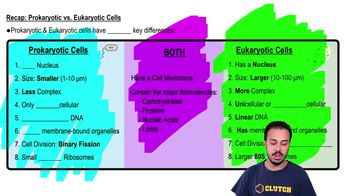
 04:26
04:26