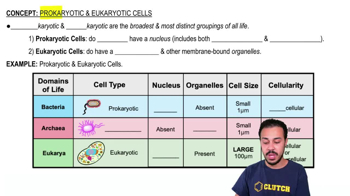
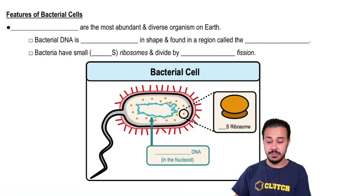
Prokaryotes are single-celled organisms lacking a nucleus, with a single circular DNA molecule located in the nucleoid region.
Which domain contains extreme thermophiles and what is a key adaptation?
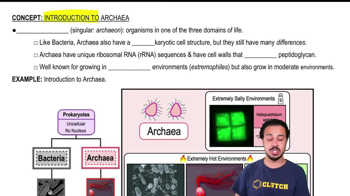
The Archaea domain contains extreme thermophiles that can grow at very high temperatures, such as 121°C, with adaptations to stabilize proteins and membranes.
What is the major role of prokaryotes in ecosystems?
Prokaryotes play key roles in nutrient cycling, including nitrogen fixation, decomposition, and supporting food webs.
What cell feature in bacteria contains peptidoglycan?
The cell wall of bacteria contains peptidoglycan, which provides structural support and protection.
Which bacterial cell features contribute to biofilm formation?
Features like the capsule and fimbriae help bacteria adhere to surfaces and form biofilms.
What bacterial structure is primarily involved in motility?
The flagella are responsible for bacterial motility.
Name the three mechanisms promoting genetic diversity in prokaryotes.
Transformation, transduction, and conjugation are the three main processes that increase genetic diversity in prokaryotes.
What is transformation in bacteria?
Transformation is the uptake and incorporation of foreign DNA from the environment into a bacterial cell, altering its genotype and possibly phenotype.
What is transduction in bacteria?
Transduction is the transfer of bacterial genes by bacteriophages (viruses that infect bacteria).
Describe bacterial conjugation.
Conjugation is a one-way transfer of DNA from a donor to a recipient bacterium via a pilus.
How are prokaryotes categorized by energy and carbon sources?
Prokaryotes are categorized as phototrophs or chemotrophs by energy source, and autotrophs or heterotrophs by carbon source.
Define photoautotrophs.
Photoautotrophs obtain energy from light and carbon from CO2 or related compounds; examples include cyanobacteria and plants.
Define chemoautotrophs.
Chemoautotrophs obtain energy from inorganic chemicals and carbon from CO2; unique to certain prokaryotes like Sulfolobus.
Define photoheterotrophs.
Photoheterotrophs use light for energy but require organic compounds as a carbon source; found in some aquatic and salt-loving prokaryotes.
Define chemoheterotrophs.
Chemoheterotrophs obtain both energy and carbon from organic compounds; includes many prokaryotes, protists, fungi, animals, and some plants.
What are the oxygen-related metabolic types in prokaryotes?
Obligate aerobes require O2, obligate anaerobes are poisoned by O2, and facultative anaerobes can survive with or without O2.
What is the endosymbiont theory?
The theory that mitochondria and chloroplasts originated from free-living bacteria engulfed by ancestral eukaryotic cells.
What distinguishes eukaryotic cells from prokaryotic cells?
Eukaryotic cells have a membrane-bound nucleus, organelles, and a well-developed cytoskeleton.
What is a protist?
Protists are mostly unicellular eukaryotes that are not plants, animals, or fungi; they form a polyphyletic group.
Name the four supergroups of eukaryotes.
The four supergroups are Excavata, SAR, Archaeplastida, and Amorphea.
What major clades make up the SAR supergroup?
SAR includes Stramenopiles, Alveolates, and Rhizarians.
Which supergroup includes plants and green algae?
The Archaeplastida supergroup includes red algae, green algae, and land plants.
What organisms are included in the Amorphea supergroup?
Amorphea includes animals, fungi, and some protists like amoebas and slime molds.
What is the significance of the Excavata supergroup?
Excavata includes protists such as human parasites like trypanosomes.
Describe the gametic life cycle in eukaryotes.
In the gametic life cycle, the diploid organism produces haploid gametes by meiosis; gametes fuse to form a diploid zygote.
Describe the alternation of generations life cycle.
Alternation of generations alternates between a diploid sporophyte and a haploid gametophyte multicellular stage.
Describe the zygotic life cycle.
In the zygotic life cycle, the haploid organism produces gametes by mitosis; the diploid zygote undergoes meiosis immediately.
 Indietro
 04:39