 Indietro
General Biology: Basic Chemistry Concepts
 02:13
02:13
Termini in questo insieme (39)
A substance made of only one type of atom.
The smallest unit of an element that still has the properties of that element.
The center/core of an atom containing protons and neutrons.
A positively charged subatomic particle found in the nucleus.
A neutral (no charge) subatomic particle found in the nucleus.
A negatively charged subatomic particle found outside the nucleus.
The number of protons in an atom.
The mass of one atom or isotope, based mainly on its protons and neutrons.
Atoms of the same element with the same number of protons but different numbers of neutrons.
An atom or molecule that has gained or lost electrons, giving it a charge.
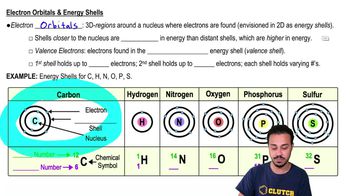
The region around the nucleus where an electron is most likely to be found.
The outermost electron shell of an atom.
The electrons located in an atom's outermost shell.
The tendency of atoms to become more stable by having 8 electrons in their outermost shell.
An atom's ability or tendency to attract electrons toward itself.
An attraction that holds atoms together.
A bond where atoms share one or more pairs of electrons.
The electrostatic attraction between oppositely charged ions, usually after electrons are transferred.
A weak attraction between partial charges of polar molecules, commonly involving a partially positive H and a partially negative atom.
Two or more atoms chemically bonded together.
A substance made of two or more different elements chemically bonded together.
A molecule made of only carbon (C) and hydrogen (H).
A carbon-containing molecule; hydrocarbons are one specific type of organic molecule.
Molecules with the same molecular formula but different arrangements of atoms.
A specific group of atoms attached to a molecule that gives it particular chemical properties.
Attraction between molecules of the same substance.
Attraction between molecules or surfaces of different substances.
The cohesive force at a liquid's surface that makes the surface resist being broken or stretched.
The movement of water through narrow spaces or tubes, caused by adhesion and cohesion.
Water-loving; attracted to water or interacts well with water.
Water-fearing; tends to avoid or not mix well with water.
A process in which reactants are transformed into products.
The substances you start with in a chemical reaction.
The substances formed or produced by a chemical reaction.
A substance that donates a proton (H⁺).
A substance that accepts H⁺ and/or provides OH⁻; it decreases H⁺ concentration.
A substance or system that resists changes in pH.
A measure of how acidic or basic a solution is.
Gaining electrons.