 Indietro
General Biology: Basic Chemistry Concepts
 02:13
02:13
Termini in questo insieme (41)
The smallest unit of matter that retains the properties of an element.
A substance that cannot be broken down into other substances by chemical reactions.
The number of protons in an atom's nucleus, defining the element.
The total number of protons and neutrons in an atom's nucleus.
Atoms of the same element with different numbers of neutrons and thus different mass numbers.
A positively charged particle found in the nucleus of an atom.
A neutral particle found in the nucleus of an atom.
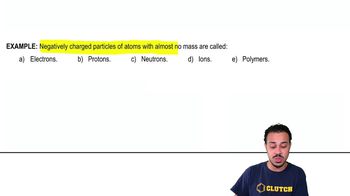
A negatively charged particle orbiting the nucleus in electron shells.
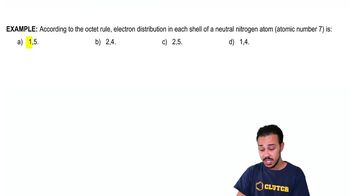
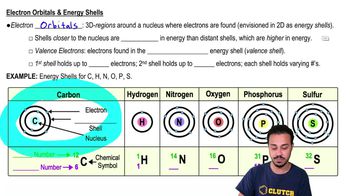
Energy levels around the nucleus where electrons are found.
The force that holds atoms together in molecules or compounds.
A chemical bond formed by the sharing of electron pairs between atoms.
A covalent bond where electrons are shared equally between atoms.
A covalent bond where electrons are shared unequally, creating partial charges.
A chemical bond formed by the attraction between oppositely charged ions.
An atom or molecule with a net electric charge due to loss or gain of electrons.
A weak bond between a hydrogen atom in one molecule and an electronegative atom in another.
The tendency of an atom to attract electrons in a chemical bond.
A substance formed by two or more different elements chemically bonded together.
Two or more atoms held together by covalent bonds.
A homogeneous mixture of two or more substances.
The substance in a solution that dissolves the solute, usually present in greater amount.
The substance dissolved in a solvent to form a solution.
A solution where water is the solvent.
A substance that increases the hydrogen ion concentration in a solution.
A substance that reduces the hydrogen ion concentration in a solution.
A scale from 0 to 14 that measures the acidity or basicity of a solution.
A substance that minimizes changes in pH by accepting or donating hydrogen ions.
Thermal energy transferred from one body to another due to temperature difference.
A measure of the intensity of heat, reflecting the average kinetic energy of molecules.
The total kinetic energy of all molecules in a substance.
The process where the surface of a liquid cools as molecules with the highest energy evaporate.
The attraction between molecules of the same substance, such as water molecules sticking together.
The attraction between molecules of different substances.
A measure of how difficult it is to stretch or break the surface of a liquid due to cohesion.
A compound resulting from the reaction of an acid and a base, often formed by ionic bonds.
A starting substance in a chemical reaction.
The substance formed as a result of a chemical reaction.
An element required by an organism in very small amounts for proper functioning.
An isotope whose nucleus decays spontaneously, emitting particles and energy.
The total number of protons and neutrons in an atom's nucleus.
Anything that has mass and takes up space.