 Indietro
General Biology: Basic Concepts and Molecular Structure
 01:05
01:05
Termini in questo insieme (15)
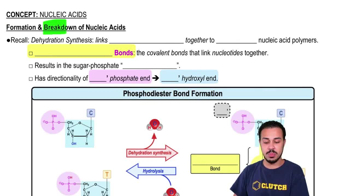
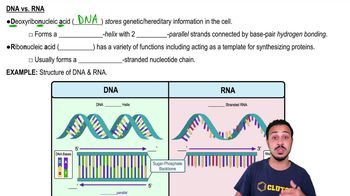
Nucleic acids are biomolecules that store and transmit genetic information in cells, including DNA and RNA.
Prokaryotes lack a nucleus and membrane-bound organelles; eukaryotes have a nucleus and organelles.
Taxonomists classify organisms into groups such as domains and kingdoms based on shared characteristics.
The three domains are Bacteria, Archaea, and Eukarya.
Kingdoms are major groups within domains, such as Animalia, Plantae, Fungi, Protista, and Monera.
Protists are mostly unicellular eukaryotes that do not fit into the other kingdoms like plants or animals.
An atom consists of a nucleus with protons and neutrons, surrounded by electrons in orbitals.
Electron configuration is the arrangement of electrons in an atom's orbitals, following energy levels and the octet rule.
The octet rule states atoms tend to gain, lose, or share electrons to have eight electrons in their outer shell.
A covalent bond is a chemical bond where atoms share one or more pairs of electrons.
Polar atoms have unequal sharing of electrons causing partial charges; nonpolar atoms share electrons equally.
A hydrogen bond is a weak attraction between a hydrogen atom in one molecule and an electronegative atom in another.
Compounds are substances formed when two or more different elements chemically bond together.
Hydrocarbons are organic compounds consisting entirely of hydrogen and carbon atoms.
An atom becomes positively charged by losing electrons and negatively charged by gaining electrons.