 Indietro
General Biology: Bioenergetics and Enzymes
 04:21

Termini in questo insieme (28)
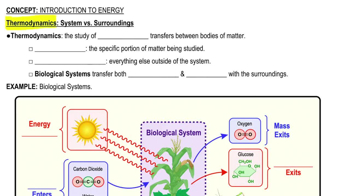
The study of how energy flows through living organisms, including how cells acquire, transform, store, and use energy.
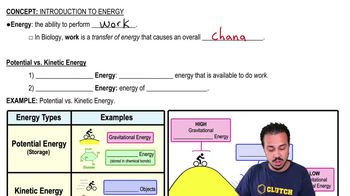
Energy of motion, such as moving molecules, a swimming fish, or flowing electrons.
Stored energy due to an object's location or structure, like water behind a dam or molecules.
Energy can be transferred and transformed but cannot be created or destroyed (conservation of energy).
Every energy transfer or transformation increases the entropy (disorder) of the universe.
A measure of disorder or randomness; higher entropy means more disorder.
A process that occurs without outside energy input, increases entropy, and decreases free energy of the system.
The portion of a system's energy that can perform work when temperature and pressure are uniform (Gibbs free energy).
ΔG = ΔH - TΔS, where ΔG is change in free energy, ΔH is change in enthalpy, T is temperature in Kelvin, and ΔS is change in entropy.
When ΔG is negative (ΔG < 0), meaning free energy decreases and the reaction releases energy.
Releases free energy (ΔG < 0), spontaneous, products have less free energy than reactants.
Absorbs free energy (ΔG > 0), nonspontaneous, products have more free energy than reactants and require energy input.
The totality of an organism's chemical reactions managing material and energy resources.
Breaks down complex molecules into simpler ones, releases energy (exergonic). Example: cellular respiration.
Builds complex molecules from simpler ones, consumes energy (endergonic). Example: photosynthesis.
Use of an exergonic process to drive an endergonic process.
Adenosine triphosphate: adenine (base) + ribose (sugar) + three phosphate groups.
Because the products of hydrolysis (ADP + Pi) are more stable and have lower free energy than ATP, releasing energy.
Energy released by ATP hydrolysis exceeds energy required by the endergonic reaction, making the overall ΔG negative and spontaneous.
A protein that acts as a biological catalyst, speeding up reactions without being consumed.
The initial energy needed to start a reaction by contorting reactants so bonds can break.
By stabilizing the transition state, lowering the energy barrier so the reaction happens faster without changing ΔG.
The region of an enzyme where the substrate binds and catalysis occurs, formed by specific amino acids.
The change in shape of the enzyme's active site upon substrate binding, enhancing substrate binding.
A molecule resembling the substrate that binds the active site, blocking substrate binding; can be overcome by increasing substrate concentration.
Binds elsewhere on the enzyme, changes its shape, and cannot be overcome by more substrate.
Regulatory molecule binds at a site other than the active site, affecting enzyme activity by stabilizing active or inactive forms.
The end product of a metabolic pathway inhibits an early enzyme in the pathway, preventing overproduction.