Skip to main content
General Biology
Il mio corso
Impara
Preparazione agli esami
AI Tutor
Guide di studio
Soluzioni per libri di testo
Flashcard
Esplora
Prova l'app
Il mio corso
Impara
Preparazione agli esami
AI Tutor
Guide di studio
Soluzioni per libri di testo
Flashcard
Esplora
Prova l'app
Indietro
General Biology: Biological Macromolecules
Puoi toccare per girare la carta.
What are the four macromolecules important to life?
Puoi toccare per girare la carta.
👆
What are the four macromolecules important to life?
Carbohydrates, Lipids, Nucleic acids, Proteins
Avanzamenti del tracciato
I pulsanti di controllo sono stati cambiati in modalità "navigazione".
1/31
Video consigliati
01:17
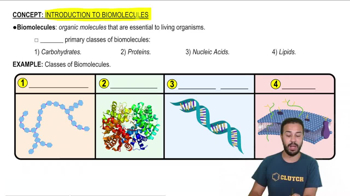
Introduction to Biomolecules
30787
views
661
rank
4
comments
01:29
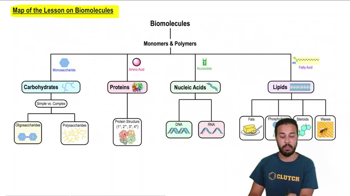
Map of the Lesson on Biomolecules
25235
views
830
rank
Termini in questo insieme (31)
Nascondere definizioni
What are the four macromolecules important to life?
Carbohydrates, Lipids, Nucleic acids, Proteins
What is the process called when monomers combine to form polymers releasing water?
Dehydration synthesis
What type of bond is formed during dehydration synthesis?
Covalent bonds
What is the process called when polymers are broken down into monomers?
Hydrolysis
What speeds up dehydration synthesis and hydrolysis reactions?
Enzymes
What is the ratio of carbon, hydrogen, and oxygen in carbohydrates?
1:2:1
Give an example of a pentose monosaccharide and a hexose monosaccharide.
Ribose (pentose), Glucose (hexose)
What is the chemical formula for glucose?
C6H12O6
What are isomers?
Molecules with the same molecular formula but different structures
What is a glycosidic bond?
A covalent bond formed between two monosaccharides
What is the most common disaccharide?
Sucrose (table sugar)
What is a polysaccharide?
A long chain of monosaccharides
What is the animal equivalent of starch?
Glycogen (highly branched)
Where is cellulose found and how do grazing animals digest it?
In plant cell walls; grazing animals have stomach flora to break it down
What carbohydrate is found in insect exoskeletons?
Chitin
What are the two main components of a fat molecule?
Glycerol and fatty acids
What type of bonds do saturated fats contain?
Only single bonds
Which type of fat is liquid at room temperature?
Unsaturated fats
Why are trans fats banned in many products?
They raise bad cholesterol and increase heart disease risk
Where are phospholipids found and why are they amphipathic?
In cell membranes; they have hydrophilic heads and hydrophobic tails
What are steroids and give two examples?
Hydrophobic lipids with ring structures; examples: testosterone and estradiol
What monomers make up proteins?
Amino acids
What bond connects amino acids in proteins?
Peptide bonds (covalent bonds)
Name the four levels of protein structure.
Primary, Secondary, Tertiary, Quaternary
What is denaturation in proteins and what causes it?
Permanent shape change affecting function; caused by temperature, pH, chemicals
What monomers make up DNA and RNA?
Nucleotides
What are the three components of a nucleotide?
Nitrogenous base, pentose sugar, phosphate group
What are the purines and pyrimidines in DNA?
Purines: Adenine, Guanine; Pyrimidines: Cytosine, Thymine
What is the shape of the DNA molecule?
Double helix
What is the base pairing rule in DNA?
A pairs with T; G pairs with C
What sugar is found in RNA?
Ribose
 IndietroIndietro
 01:17