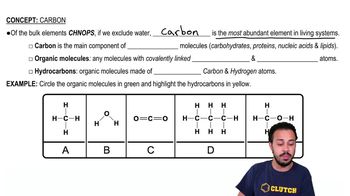
Carbon has 4 electrons in its valence shell, allowing it to form 4 covalent bonds with other atoms, enabling the formation of large, complex, and diverse organic molecules.
What are isomers?
Compounds with the same molecular formula but different structural arrangements, resulting in different shapes and properties.
What are hydrocarbons and their biological significance?
Molecules consisting only of carbon and hydrogen; they are major components of petroleum and provide energy, and hydrocarbon chains are found in fats as energy sources.
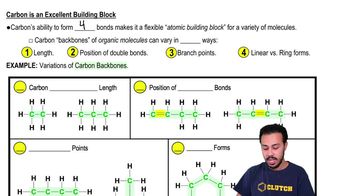
List four ways carbon skeletons can vary.
Length, branching, presence and location of double bonds, and ring formation.
What are functional groups and why are they important?
Specific groups of atoms attached to carbon skeletons that affect a molecule's function by participating in chemical reactions and influencing polarity and solubility.
Name six important chemical groups in biological molecules.
A chemical reaction that links monomers by removing a water molecule, forming a covalent bond.
What is hydrolysis?
A reaction that breaks polymers into monomers by adding a water molecule, reversing dehydration.
What are the four main classes of biological macromolecules?
Carbohydrates, lipids, proteins, and nucleic acids.
What are monosaccharides?
Simple sugars that serve as monomers for carbohydrates, typically with molecular formulas that are multiples of CH2O.
How do glucose and fructose differ despite having the same formula?
They are isomers differing in the arrangement of atoms, especially the position of the carbonyl group.
What is a disaccharide and how is it formed?
A sugar composed of two monosaccharides linked by a dehydration reaction.
Compare starch and cellulose.
Both are glucose polymers; starch is helical and used for energy storage in plants, while cellulose has a different linkage forming straight fibers for structural support.
Why are lipids hydrophobic?
Because they contain mostly nonpolar hydrocarbon chains that do not interact well with water.
What distinguishes saturated from unsaturated fatty acids?
Saturated fatty acids have no double bonds and are solid at room temperature; unsaturated fatty acids have one or more double bonds causing kinks and are liquid at room temperature.
What are trans fats and why are they harmful?
Trans fats are unsaturated fats that have been hydrogenated to be more solid; they increase the risk of heart disease more than saturated fats.
What is the structure and function of phospholipids?
Phospholipids have two fatty acids and a phosphate group attached to glycerol; they form the bilayer of cell membranes with hydrophilic heads and hydrophobic tails.
What are steroids and their biological role?
Lipids with a carbon skeleton of four fused rings; cholesterol is a steroid important in cell membranes and as a precursor to sex hormones.
What are proteins and their primary function?
Polymers of amino acids that perform diverse functions including catalysis (enzymes), transport, defense, signaling, movement, and structural support.
What determines a protein's function?
Its unique three-dimensional shape, which depends on the amino acid sequence and folding.
What is denaturation?
The process where a protein unravels and loses its shape and function due to factors like heat or pH changes.
What are amino acids composed of?
A central carbon bonded to an amino group, a carboxyl group, a hydrogen atom, and a variable R group.
How are amino acids linked to form proteins?
By peptide bonds formed through dehydration reactions between the carboxyl group of one amino acid and the amino group of another.
What are the four levels of protein structure?
Primary (amino acid sequence), secondary (alpha helices and beta sheets), tertiary (3D folding), and quaternary (assembly of multiple polypeptides).
What are nucleotides?
Monomers of nucleic acids composed of a five-carbon sugar, a phosphate group, and a nitrogenous base.
What bases are found in DNA and RNA?
DNA has adenine (A), thymine (T), cytosine (C), guanine (G); RNA has A, uracil (U), C, and G.
How do DNA strands pair in the double helix?
A pairs with T, and C pairs with G via hydrogen bonds, making the strands complementary.
What is the central dogma of molecular biology?
DNA is transcribed into RNA, which is then translated into proteins.
What is lactose tolerance and its evolutionary significance?
The ability to digest lactose into adulthood due to a recent genetic mutation, providing a survival advantage in populations with dairy farming.
 Indietro
 03:35