Skip to main content
General Biology
Il mio corso
Impara
Preparazione agli esami
AI Tutor
Guide di studio
Soluzioni per libri di testo
Flashcard
Esplora
Prova l'app
Il mio corso
Impara
Preparazione agli esami
AI Tutor
Guide di studio
Soluzioni per libri di testo
Flashcard
Esplora
Prova l'app
Indietro
General Biology: Biomolecules and Macromolecules (unit 1)
Puoi toccare per girare la carta.
What are the four main classes of biological macromolecules?
Puoi toccare per girare la carta.
👆
What are the four main classes of biological macromolecules?
Nucleic acids
,
Proteins
,
Carbohydrates
, and
Lipids
.
Avanzamenti del tracciato
I pulsanti di controllo sono stati cambiati in modalità "navigazione".
1/20
Video consigliati
03:35
Carbon is an Excellent Building Block
22651
views
902
rank
04:19
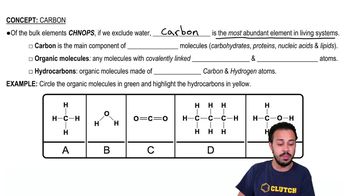
Carbon
29831
views
705
rank
2
comments
Termini in questo insieme (20)
Nascondere definizioni
What are the four main classes of biological macromolecules?
Nucleic acids
,
Proteins
,
Carbohydrates
, and
Lipids
.
What is a polymer and what are its building blocks called?
A
polymer
is a large molecule made of repeating smaller units called
monomers
.
What process builds polymers from monomers?
Dehydration synthesis
(condensation) removes water to form bonds between monomers.
What process breaks polymers into monomers?
Hydrolysis
adds water to break bonds and release monomers.
Why is carbon important in biological molecules?
Carbon can form
four bonds
, branch in multiple directions, and create diverse molecules essential for life.
What are functional groups in organic molecules?
Specific groups of atoms attached to carbon skeletons that determine chemical properties and reactions.
Name three important functional groups in biomolecules.
Hydroxyl (-OH)
,
Carboxyl (-COOH)
, and
Amino (-NH2)
groups.
What is the monomer and polymer of carbohydrates?
Monomer:
Monosaccharide
; Polymer:
Polysaccharide
.
What monomers make up proteins and what is the polymer called?
Monomers:
Amino acids
; Polymer:
Polypeptide
or protein.
What type of bond links amino acids in proteins?
Peptide bonds
formed by dehydration synthesis link amino acids.
What determines the unique properties of amino acids?
The
side chain (R group)
determines polarity, charge, and behavior.
What are the four levels of protein structure?
Primary
(amino acid sequence),
Secondary
(alpha helices and beta sheets),
Tertiary
(3D folding), and
Quaternary
(multi-subunit assembly).
How do changes in pH or temperature affect proteins?
They can
denature
proteins by disrupting hydrogen and ionic bonds, altering shape and function.
What is the monomer of nucleic acids and what polymers do they form?
Monomer:
Nucleotide
; Polymers:
DNA
and
RNA
.
What are the three parts of a nucleotide?
A
sugar
, a
phosphate group
, and a
nitrogenous base
.
What is the difference between DNA and RNA sugars?
DNA contains
deoxyribose
(lacking 2' OH), RNA contains
ribose
(with 2' OH).
Which nitrogenous bases are purines and which are pyrimidines?
Purines:
Adenine (A), Guanine (G);
Pyrimidines:
Cytosine (C), Thymine (T), Uracil (U).
How do bases pair in DNA?
A pairs with T via two hydrogen bonds; G pairs with C via three hydrogen bonds.
What type of bond links nucleotides in a nucleic acid strand?
Phosphodiester bonds
link the 3' hydroxyl of one sugar to the 5' phosphate of the next.
What is ATP and why is it important?
Adenosine Triphosphate (ATP)
is the cell's main energy currency, providing energy for cellular processes.
 IndietroIndietro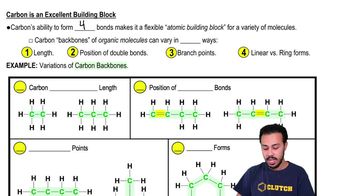
 03:35
03:35