Indietro

General Biology: Biomolecules and Their Properties

I pulsanti di controllo sono stati cambiati in modalità "navigazione".
1/31
  • Why is carbon a key element in biological molecules?

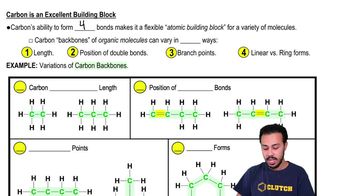
    Carbon can form 4 covalent bonds, allowing it to create diverse molecules with varying lengths, branching, double bonds, and ring structures.
  • What defines an organic molecule?

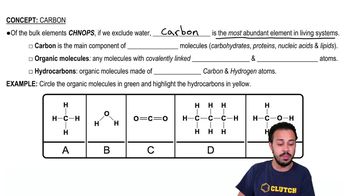
    Organic molecules contain covalently linked carbon and hydrogen atoms.
  • What are hydrocarbons?

    Organic molecules made only of carbon and hydrogen atoms.
  • List the four ways carbon backbones can vary.

    Length, position of double bonds, branch points, and linear vs. ring forms.
  • What are functional groups in biomolecules?

    Groups of atoms that are reactive and commonly found together, typically extending off carbon backbones.
  • Name the seven common functional groups in biology.

    Methyl, Hydroxyl, Carbonyl, Carboxyl, Amino, Phosphate, Sulfhydryl.
  • What are monomers and polymers?

    Monomers are single building blocks; polymers are long chains of monomers linked together.
  • Which biomolecules have consistent monomers forming polymers?

    Carbohydrates (monosaccharides), Proteins (amino acids), and Nucleic acids (nucleotides).
  • How are polymers built and broken down?

    Built by dehydration synthesis (removing water) and broken down by hydrolysis (adding water).
  • What is the general formula for simple carbohydrates?

    Cₙ(H₂O)ₙ, where n is the number of carbon atoms.
  • Differentiate monosaccharides, oligosaccharides, and polysaccharides.

    Monosaccharides: single sugar units; Oligosaccharides: 2-20 linked sugars; Polysaccharides: >20 linked sugars.
  • What type of bond links monosaccharides in polysaccharides?

    Glycosidic bonds.

  • What are the two main functions of carbohydrates?

    Structural support (e.g., cellulose, chitin) and energy storage (e.g., starch, glycogen).
  • What are proteins made of?

    Polymers of amino acid monomers linked by peptide bonds.
  • What are the components of an amino acid?

    Central carbon (α-carbon), amino group, carboxyl group, hydrogen atom, and a unique R-group.
  • What determines the properties of amino acids?

    The R-group or side chain.
  • Describe the four levels of protein structure.

    Primary: amino acid sequence; Secondary: α-helices and β-sheets; Tertiary: 3D folding; Quaternary: multiple polypeptide chains.
  • What causes secondary protein structures?

    Hydrogen bonding between atoms of the peptide backbone.
  • What is protein denaturation?

    Loss of protein's 3D structure and function due to environmental changes like heat or pH.
  • What role do chaperone proteins play?

    Help denatured proteins refold into their functional shapes.
  • What are nucleic acids and their monomers?

    Polymers that store genetic information; monomers are nucleotides.
  • What are the three components of a nucleotide?

    Phosphate group, pentose sugar, and nitrogenous base.
  • How do DNA and RNA sugars differ?

    DNA has deoxyribose (lacks one hydroxyl group), RNA has ribose.
  • Name the five nitrogenous bases and their groups.

    Pyrimidines: Cytosine, Thymine (DNA), Uracil (RNA); Purines: Adenine, Guanine.
  • What are the base pairing rules in DNA?

    A pairs with T; C pairs with G.
  • What bonds link nucleotides in nucleic acids?

    Phosphodiester bonds form the sugar-phosphate backbone.
  • Describe the structure and function of lipids.

    Hydrophobic biomolecules, not polymers, including fats, phospholipids, steroids, and waxes.

  • What are saturated and unsaturated fatty acids?

    Saturated: no double bonds, solid at room temp; Unsaturated: ≥1 double bond, liquid at room temp.
  • What is a triglyceride?

    A lipid made of 3 fatty acids linked to glycerol via dehydration synthesis.
  • What is the structure and role of phospholipids?

    Amphipathic molecules with hydrophilic heads and hydrophobic tails; major component of cell membranes.
  • What are steroids and waxes?

    Steroids: lipids with 4 fused carbon rings (e.g., cholesterol); Waxes: lipids for protection and water loss prevention.