Indietro

General Biology: Biomolecules and Water Properties

I pulsanti di controllo sono stati cambiati in modalità "navigazione".
1/23
  • What are the four main classes of biological macromolecules?

    Nucleic acids, Proteins, Carbohydrates, and Lipids.
  • What is a polymer and what are its building blocks?

    A polymer is a large molecule made of repeating smaller units called monomers.
  • What process builds polymers from monomers?

    Dehydration synthesis removes water to form bonds between monomers, creating polymers.

  • What process breaks polymers into monomers?

    Hydrolysis adds water to break bonds, separating polymers into monomers.
  • What is the monomer and polymer for proteins?

    Monomer: Amino acids; Polymer: Polypeptides or Proteins.
  • What functional groups are present in amino acids?

    Amino acids have an amino group (-NH2) and a carboxyl group (-COOH).
  • How do amino acids link to form polypeptides?

    Amino acids link by peptide bonds formed via dehydration synthesis.
  • What determines the properties and folding of a protein?

    The side chains (R groups) of amino acids determine protein folding and function.
  • What are the four levels of protein structure?

    Primary (amino acid sequence), Secondary (alpha helices and beta sheets), Tertiary (3D folding), and Quaternary (multi-subunit assembly).
  • What causes protein denaturation?

    Changes in temperature or pH disrupt hydrogen and ionic bonds, causing loss of protein structure and function.
  • What is the monomer and polymer of nucleic acids?

    Monomer: Nucleotide; Polymer: DNA or RNA.
  • What are the three parts of a nucleotide?

    A phosphate group, a pentose sugar (ribose or deoxyribose), and a nitrogenous base.
  • How are nucleotides linked in nucleic acids?

    Nucleotides are linked by phosphodiester bonds between the 3' hydroxyl and 5' phosphate groups.
  • What is the difference between DNA and RNA sugars?

    DNA contains deoxyribose (lacks 2' OH), RNA contains ribose (has 2' OH).
  • Which nitrogenous bases pair in DNA?

    Adenine (A) pairs with Thymine (T), and Guanine (G) pairs with Cytosine (C).
  • What type of bonds hold DNA base pairs together?

    Base pairs are held by hydrogen bonds: A-T has 2 bonds, G-C has 3 bonds.
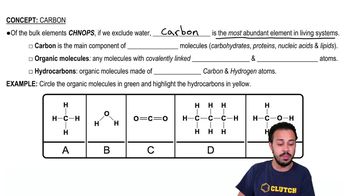
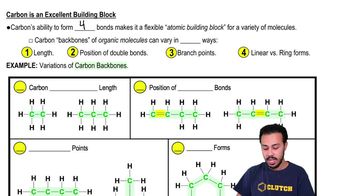
  • Why is carbon important in biological molecules?

    Carbon can form four covalent bonds, allowing diverse and complex organic molecules.
  • What are functional groups and why are they important?

    Functional groups are specific atom groups that determine molecule reactivity and properties.
  • What is the difference between hydrophilic and hydrophobic molecules?

    Hydrophilic molecules are polar and water-loving; hydrophobic molecules are nonpolar and water-fearing.
  • What are the emergent properties of water due to hydrogen bonding?

    Water exhibits cohesion, adhesion, high specific heat, ice floats, and is a good solvent for polar molecules.
  • What is pH and how is it related to hydrogen ion concentration?

    pH is the negative logarithm of hydrogen ion concentration: \(\mathrm{pH} = -\log_{10}[H^+]\).
  • How do acids and bases affect pH?

    Acids donate H+ lowering pH; bases accept H+ raising pH.
  • What is the role of buffers in biological systems?

    Buffers resist changes in pH by absorbing or releasing H+ ions.