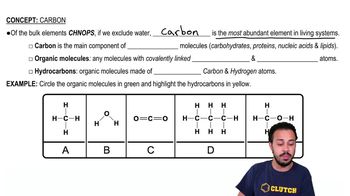
Most abundant element in living systems excluding water
Carbon is the most abundant element in living systems after excluding water.
Definition of organic molecules
Organic molecules contain covalently linked carbon and hydrogen atoms.
What are hydrocarbons?
Hydrocarbons are organic molecules made only of carbon and hydrogen atoms.
Why is carbon an excellent building block?
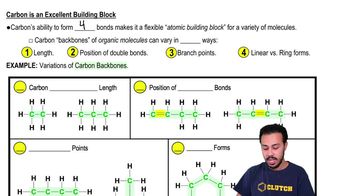
Carbon forms four covalent bonds, allowing flexible molecular structures with variations in length, double bond position, branching, and ring formation.
What are functional groups?
Functional groups are reactive groups of atoms commonly found attached to carbon backbones that determine molecule properties.
Primary classes of biomolecules
The four primary biomolecule classes are carbohydrates, proteins, nucleic acids, and lipids.
Difference between monomers and polymers
Monomers are individual building blocks; polymers are long chains of monomers linked covalently.
What is dehydration synthesis?
Dehydration synthesis forms covalent bonds between monomers by removing water, building polymers.
What is hydrolysis?
Hydrolysis breaks covalent bonds in polymers by adding water, releasing monomers.
General formula of simple carbohydrates
Simple carbohydrates fit the formula \(C_n(H_2O)_n\), e.g., glucose.
Three size classes of carbohydrates
Monosaccharides (single units), disaccharides (2-~10 units), and polysaccharides (20+ units).
Bond linking monosaccharides
Monosaccharides are linked by glycosidic bonds formed via dehydration synthesis.
Two main functions of carbohydrates
Carbohydrates provide structural support (e.g., cellulose) and energy storage (e.g., starch, glycogen).
Monomers of proteins
Proteins are polymers made of amino acid monomers.
Covalent bond linking amino acids
A peptide bond covalently links adjacent amino acids.
Environmental changes like heat, pH, or salt concentration can cause proteins to lose their functional shape.
Role of chaperone proteins
Chaperones assist in protein folding and help denatured proteins regain their proper shape.
Monomers of nucleic acids
Nucleic acids are polymers of nucleotides.
Three components of a nucleotide
A nucleotide consists of a phosphate group, a pentose sugar, and a nitrogenous base.
Difference between DNA and RNA sugars
DNA contains deoxyribose (lacking one hydroxyl group), RNA contains ribose.
Two groups of nitrogenous bases
Pyrimidines (single-ring: cytosine, thymine, uracil) and purines (double-ring: adenine, guanine).
Base pairing in DNA
Adenine pairs with thymine, and cytosine pairs with guanine via hydrogen bonds.
Bond linking nucleotides
Nucleotides are linked by phosphodiester bonds formed by dehydration synthesis.
DNA structure
DNA is a double helix with two antiparallel strands connected by base-pair hydrogen bonds.
Definition of lipids
Lipids are hydrophobic biomolecules that do not form polymers and include fats, phospholipids, steroids, and waxes.
Difference between saturated and unsaturated fatty acids
Saturated fatty acids have only single C-C bonds and are solid at room temperature; unsaturated have one or more C=C double bonds causing kinks and are liquid.
Structure of triglycerides
Triglycerides consist of three fatty acid chains covalently linked to a glycerol molecule.
Phospholipid structure and function
Phospholipids have hydrophilic heads and hydrophobic tails and are major components of cell membranes.
Role of steroids and waxes
Steroids have fused carbon rings important for membrane structure; waxes protect and prevent water loss.
 Indietro
 03:35