Skip to main content
General Biology
Il mio corso
Impara
Preparazione agli esami
AI Tutor
Guide di studio
Soluzioni per libri di testo
Flashcard
Esplora
Prova l'app
Il mio corso
Impara
Preparazione agli esami
AI Tutor
Guide di studio
Soluzioni per libri di testo
Flashcard
Esplora
Prova l'app
Indietro
General Biology: Carbon and Organic Molecules
Puoi toccare per girare la carta.
What determines acidity in water?
Puoi toccare per girare la carta.
👆
What determines acidity in water?
The amount of
H⁺
(hydronium ions) determines acidity, measured by the
pH scale
.
Avanzamenti del tracciato
I pulsanti di controllo sono stati cambiati in modalità "navigazione".
1/21
Video consigliati
03:35
Carbon is an Excellent Building Block
22808
views
905
rank
04:19
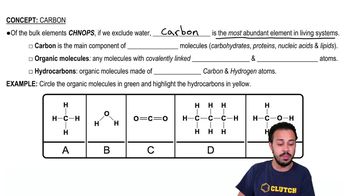
Carbon
30026
views
713
rank
2
comments
Termini in questo insieme (21)
Nascondere definizioni
What determines acidity in water?
The amount of
H⁺
(hydronium ions) determines acidity, measured by the
pH scale
.
What role do buffers play in biological systems?
Buffers help prevent big changes in pH by
accepting or donating H⁺
, maintaining stable cellular pH.
Why is carbon essential for life?
Carbon can form
4 covalent bonds
, allowing it to build a huge variety of simple and complex molecules essential for life.
What is organic chemistry?
The study of compounds that contain
carbon
.
Name the 'Big 6' major elements in biological molecules.
Carbon, hydrogen, oxygen, nitrogen, sulfur, and phosphorus
.
How many bonds can carbon form and why?
Carbon has
4 valence electrons
and can form
4 covalent bonds
to complete its outer shell.
What shape do carbon's four covalent bonds form?
A
tetrahedral shape
, with bonds spreading out in 3D around the carbon atom.
What are carbon skeletons?
Chains of carbon atoms that form the
backbone
of organic molecules, varying in length, shape, branching, double bonds, and rings.
What are hydrocarbons?
Molecules made only of
carbon and hydrogen
, often linear chains that store chemical energy.
Define isomers.
Molecules with the
same molecular formula
but different
structures or properties
.
What are structural isomers?
Isomers with the same atoms but different
covalent bond arrangements
.
What are cis-trans isomers?
Isomers with the same covalent bonds but different
spatial arrangements
of atoms.
What are enantiomers?
Molecules that are
mirror images
of each other, like right and left hands.
Why do small differences in isomer structure matter biologically?
Because molecular shape affects function, different isomers can have very different biological effects.
How can carbon structures be distinguished?
By their
carbon skeleton
and the
attached chemical groups
.
What are functional groups?
Parts of organic molecules that participate in chemical reactions and give molecules specific properties.
List the seven important functional groups in biology (CASHCMP).
Carbonyl, Amino, Sulfhydryl, Hydroxyl, Carboxyl, Methyl, Phosphate
.
What is ATP and why is it important?
Adenosine triphosphate (ATP) stores and releases chemical energy for cellular processes.
How does ATP store energy?
Energy is stored in the
high-energy phosphate bonds
, especially due to repulsion between negatively charged phosphate groups.
What happens when ATP reacts with water?
ATP releases energy that cells can use by breaking a phosphate bond.
Why is carbon considered the fundamental element of life?
Because it can form
4 covalent bonds
, enabling the formation of countless organic molecules essential for life.
 IndietroIndietro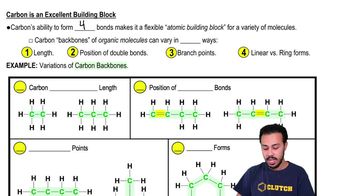
 03:35
03:35