Indietro

General Biology: Carbon, Macromolecules, Proteins, and Nucleic Acids

I pulsanti di controllo sono stati cambiati in modalità "navigazione".
1/26
  • Why is carbon important in biology?

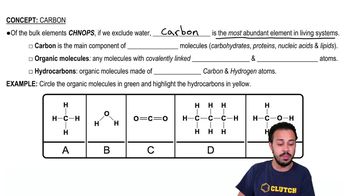
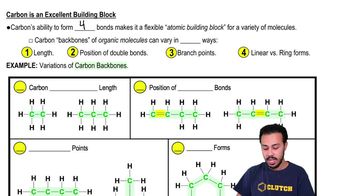
    Carbon can form 4 covalent bonds, allowing it to connect with other carbons, hydrogen, oxygen, nitrogen, sulfur, etc., enabling chains, branches, double bonds, and rings.
  • What is a hydrocarbon?

    A molecule containing only carbon and hydrogen, such as methane and many petroleum components.
  • What are isomers?

    Molecules with the same molecular formula but different arrangements of atoms, leading to different properties.
  • What are functional groups?

    Small groups of atoms attached to carbon skeletons that give molecules their chemical properties.
  • Name key functional groups and their properties.

    • Hydroxyl (–OH): polar, hydrophilic
    • Carbonyl (C=O): polar
    • Carboxyl (–COOH): acidic
    • Amino (–NH₂): basic
    • Sulfhydryl (–SH): stabilizes proteins
    • Phosphate (–OPO₃²⁻): important in ATP/DNA
    • Methyl (–CH₃): nonpolar
  • What are carbohydrates?

    Sugars and sugar polymers, including monosaccharides (one sugar), disaccharides (two sugars), and polysaccharides (many sugars linked).
  • Examples of important polysaccharides and their functions.

    • Starch: plant glucose storage
    • Glycogen: animal glucose storage, highly branched
    • Cellulose: plant cell walls, indigestible by humans
    • Chitin: arthropod exoskeletons and fungal cell walls
  • Why are structural polysaccharides strong?

    They form strong, organized structures with extensive hydrogen bonding, providing support and protection.
  • Why don't lipids dissolve well in water?

    Lipids are mostly nonpolar and hydrophobic, while water is polar, so they do not mix well.
  • What are the three major lipid categories?

    • Fats: long-term energy storage
    • Phospholipids: main component of cell membranes
    • Steroids: four fused carbon rings
  • What is a triglyceride composed of?

    One glycerol molecule linked to three fatty acids via ester linkages, formed by dehydration reactions.
  • Difference between saturated and unsaturated fats.

    Saturated fats have no C=C double bonds and are usually solid at room temperature; unsaturated fats have one or more double bonds causing kinks and are usually liquid.
  • Structure and properties of phospholipids.

    Phospholipids have a hydrophilic phosphate head and two hydrophobic fatty acid tails, forming bilayers in cell membranes.
  • What is the signature structure of steroids?

    Four fused carbon rings; cholesterol is a major steroid in cell membranes.
  • What are proteins made of?

    Proteins are polymers of amino acids, linked by peptide bonds.
  • What determines an amino acid's identity and properties?

    The R-group attached to the α-carbon determines the amino acid's identity and chemical properties.
  • What are peptide bonds?

    Covalent bonds that link amino acids together, formed by dehydration synthesis.
  • Describe the four levels of protein structure.

    • Primary: amino acid sequence
    • Secondary: local folding (α-helix, β-sheet) stabilized by hydrogen bonds
    • Tertiary: overall 3D shape of one polypeptide from R-group interactions
    • Quaternary: interaction of multiple polypeptide chains
  • Why is protein structure important for function?

    A protein's 3D shape determines its function; changes in shape can disrupt function.
  • What are nucleic acids and their monomers?

    Nucleic acids (DNA and RNA) are polymers of nucleotides, each containing a sugar, phosphate group, and nitrogenous base.
  • Differences between DNA and RNA.

    • DNA: deoxyribose sugar, thymine base, usually double-stranded
    • RNA: ribose sugar, uracil base, usually single-stranded
  • What are purines and pyrimidines?

    Purines (adenine and guanine) have two rings; pyrimidines (cytosine, thymine, uracil) have one ring.
  • Base pairing rules in DNA and RNA.

    In DNA, A pairs with T and C pairs with G; in RNA, A pairs with U.
  • What is the significance of 5′ and 3′ ends in nucleic acids?

    5′ end has a phosphate group; 3′ end has an OH group; strands run antiparallel (one 5′→3′, the other 3′→5′).
  • Outline the flow of genetic information.

    DNA is transcribed into RNA, which is translated into protein.
  • Name the three major types of RNA and their functions.

    • mRNA: messenger, carries genetic code
    • tRNA: transfer, brings amino acids
    • rRNA: ribosomal, part of ribosomes