 Indietro
General Biology: Cell Division and Cancer Study Guide
 04:45

Termini in questo insieme (57)
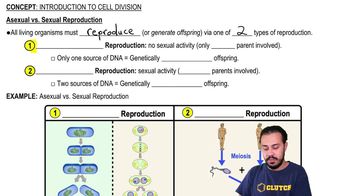
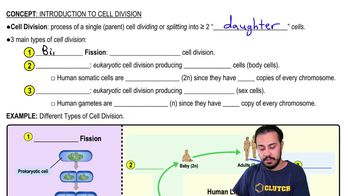
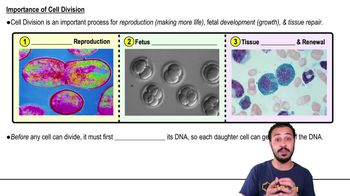
The process by which a parent cell divides into two or more daughter cells.
The phase of the cell cycle where the cell grows and DNA is replicated before mitosis.
A type of cell division that results in two genetically identical daughter cells.
The division of the cytoplasm to form two separate daughter cells after mitosis.
The complete set of genetic material in a cell or organism.
Structures made of DNA and proteins that contain genetic information.
The region of a chromosome where sister chromatids are joined together.
Two identical copies of a chromosome connected by a centromere.
The complex of DNA and proteins in the nucleus that condenses to form chromosomes during cell division.
Proteins around which DNA winds to form nucleosomes, aiding chromosome structure.
The process of chromatin becoming tightly packed into visible chromosomes during mitosis.
Cells that give rise to gametes (sperm and eggs) and pass genetic information to offspring.
Haploid reproductive cells (sperm and egg) that combine during fertilization.
All body cells except germ line cells; typically diploid.
A cell with a single set of chromosomes (n), such as gametes.
A cell with two sets of chromosomes (2n), one from each parent.
Cells or organisms with more than two sets of chromosomes.
A type of cell division that reduces chromosome number by half, producing haploid gametes.
The series of phases a cell goes through to grow and divide: G1, S, G2, and M phases.
The phase of the cell cycle that includes mitosis and cytokinesis.
The first gap phase where the cell grows and prepares for DNA replication.
The phase of the cell cycle where DNA replication occurs.
The second gap phase where the cell prepares for mitosis.
The first stage of mitosis where chromosomes condense and the mitotic spindle begins to form.
The mitotic phase where the nuclear envelope breaks down and spindle fibers attach to kinetochores.
The stage of mitosis where chromosomes align at the metaphase plate.
The stage where sister chromatids separate and move toward opposite poles.
The final stage of mitosis where nuclear envelopes reform around separated chromosomes.
Organelles that help organize the mitotic spindle in animal cells.
The microtubule organizing center that duplicates before mitosis and forms spindle poles.
The membrane surrounding the nucleus that breaks down during prometaphase.
Structures within the nucleus involved in ribosome synthesis; disappear during mitosis.
A structure of microtubules that segregates chromosomes during mitosis.
Star-shaped microtubule arrays that form around centrosomes during mitosis.
Cytoskeletal fibers that form the mitotic spindle and help move chromosomes.
Protein complexes on centromeres where spindle fibers attach during mitosis.
The imaginary plane where chromosomes line up during metaphase.
Proteins that hold sister chromatids together until anaphase.
The indentation that begins cytokinesis in animal cells.
A ring of actin and myosin filaments that pinches the cell membrane during cytokinesis.
A structure that forms during cytokinesis in plant cells to separate daughter cells.
A form of asexual reproduction in prokaryotes where the cell divides into two identical cells.
A control point where the cell decides to divide, delay, or enter a resting state.
Ensures DNA is replicated correctly before the cell proceeds to G2.
Checks for DNA damage and completeness of replication before mitosis.
Ensures all chromosomes are properly attached to the spindle before anaphase.
A disease characterized by uncontrolled cell division and the ability to invade other tissues.
The formation of new blood vessels that tumors stimulate to supply nutrients.
Mutated proto-oncogenes that promote uncontrolled cell division.
Normal genes that regulate cell growth and division but can become oncogenes if mutated.
Genes that inhibit cell division or promote apoptosis to prevent cancer.
A tumor-suppressor protein that regulates the cell cycle and can induce apoptosis if DNA is damaged.
A non-cancerous growth that does not invade nearby tissues.
A cancerous growth that can invade and destroy surrounding tissues.
A tumor formed when cancer cells spread to distant parts of the body.
A cancer treatment that uses high-energy radiation to kill cancer cells.
A cancer treatment using drugs that kill rapidly dividing cells.