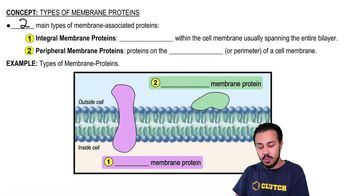
Passive transport moves substances down their concentration gradient without energy; active transport requires energy to move substances against the gradient.
Osmosis
The diffusion of water across a semipermeable membrane from low to high solute concentration.
Tonicity and water movement
Hypertonic: water leaves cell; Hypotonic: water enters cell; Isotonic: no net water movement.
Sodium-potassium pump function
Uses ATP to pump 3 Na+ out and 2 K+ into the cell, maintaining electrochemical gradients essential for cell function.
Electrochemical gradient
Combined effect of concentration gradient and electrical charge difference across a membrane influencing ion movement.
Facilitated diffusion
Passive transport of molecules across membranes via specific transport proteins or channels.
Exocytosis vs endocytosis
Exocytosis exports materials via vesicles; endocytosis imports materials by engulfing them with the membrane.
Paracrine, synaptic, and endocrine signaling
Paracrine and synaptic are local signals; endocrine signaling is long-distance via hormones in the bloodstream.
Three stages of cell signaling
Reception (signal detected), transduction (signal relayed and amplified), and response (cellular action).
G protein-coupled receptor signaling pathway
Ligand binds receptor, activates G protein, which triggers downstream effectors to produce a cellular response.
Signal transduction purpose
Converts an extracellular signal into a specific intracellular response, often amplifying the signal.
Second messengers (e.g., cAMP)
Small molecules that relay signals inside the cell, amplifying and distributing the signal.
Hormones
Chemical messengers secreted by endocrine glands that regulate physiology and behavior.
 Indietro
 03:54