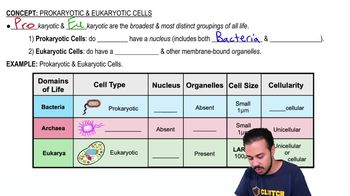
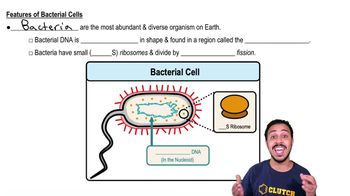
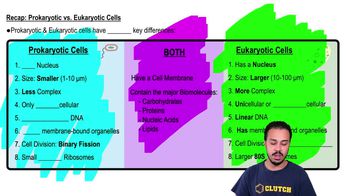
Key differences between prokaryotic and eukaryotic cells
Prokaryotic cells have a stiff cell wall, single circular chromosome in nucleoid, plasmids, and external appendages like fimbriae and flagella. Eukaryotic cells have a nucleus, membrane-bound organelles, and complex cytoskeleton.
Function of fimbriae vs flagella in prokaryotes
Fimbriae are short, sticky appendages used for attachment. Flagella are long, hair-like structures used for movement.
Organelles containing their own DNA in eukaryotic cells
Mitochondria and chloroplasts contain their own DNA, supporting the endosymbiosis theory.
Role of centrosomes and centrioles in animal cells
Centrosomes are microtubule organizing centers containing two bundles of microtubules called centrioles, important for cell division. Plants lack centrioles but have microtubules.
Function of lysosomes
Lysosomes act as recycling centers containing acid hydrolases that digest macromolecules and damaged organelles at acidic pH (~5.0).
Differences in plant and animal cells
Plant cells have a cell wall and chloroplasts, while animal cells have centrioles and lysosomes but lack cell walls and chloroplasts.
Endosymbiosis theory
Proposes mitochondria and chloroplasts evolved from free-living bacteria engulfed by ancestral eukaryotes, leading to a mutually beneficial relationship.
Nuclear envelope structure and function
The nuclear envelope has two membranes with nuclear pores that regulate import/export of proteins and RNA between nucleus and cytoplasm.
Nuclear localization signal (NLS)
A 17 amino acid sequence that acts as a molecular zip code directing proteins from cytosol into the nucleus.
Components of the endomembrane system
Includes nucleus, rough and smooth ER, Golgi apparatus, vesicles, lysosomes, and plasma membrane; involved in synthesis, processing, and transport of proteins and lipids.
ER signal sequence and protein targeting
A 20 amino acid sequence on growing polypeptides that binds signal recognition particle (SRP) directing ribosomes to the ER membrane for protein translocation.
Role of the translocon in the ER
A channel in the ER membrane through which growing proteins enter the ER lumen during synthesis.
Pathway of protein secretion
Proteins synthesized in the rough ER are processed in the Golgi apparatus, packaged into vesicles, and secreted via exocytosis at the plasma membrane.
Difference between acid hydrolase targeting and secretion
Acid hydrolases are targeted to lysosomes to digest waste and are not secreted outside the cell, unlike some secreted proteins.
Exocytosis process
Release of intracellular molecules contained in membrane-bound vesicles by fusion of vesicles with the plasma membrane.
Function of insulin protein hormone
Lowers blood glucose levels; synthesized from mRNA in ER, processed in Golgi, and secreted by exocytosis.
Role of protein hormone receptors
Bind protein hormones on the cell surface to trigger cellular responses; receptors are transported to the plasma membrane but not secreted.
Cytoskeleton filament types and functions
Actin filaments maintain cell shape and enable movement; intermediate filaments provide tensile strength; microtubules resist compression, assist cell division, and intracellular transport.
Actin and myosin interaction
Drive cell movement, cytoplasmic streaming, and cytokinesis in animal cells.
Size comparison of prokaryotic and eukaryotic cells
Prokaryotic cells are about 10 times smaller in diameter and 1000 times smaller in volume than eukaryotic cells.
 Indietro
 04:26