 Indietro
General Biology: Cell Structure and Function
 04:26
04:26
Termini in questo insieme (26)
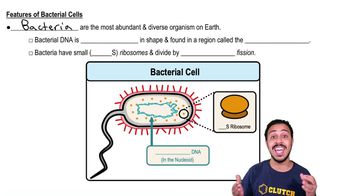
Plasma membrane, cytosol, chromosomes, and ribosomes.
1. All living organisms are composed of one or more cells.
2. The cell is the basic unit of structure and organization.
3. Cells arise only from pre-existing cells.
Smaller cells have a higher surface-area-to-volume ratio, allowing efficient exchange of nutrients and wastes across the plasma membrane.
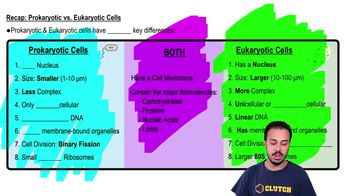
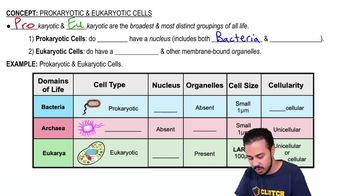
Prokaryotes lack a nucleus and membrane-bound organelles; eukaryotes have a nucleus and membrane-bound organelles like ER and mitochondria.
Cell wall (cellulose), chloroplasts, and a large central vacuole.
A phospholipid bilayer with embedded proteins that controls entry and exit of substances, maintaining the cell's internal environment.
Houses DNA, controls gene expression, and is the site of ribosomal RNA synthesis in the nucleolus.
Free ribosomes synthesize proteins for cytosol; bound ribosomes make proteins for secretion or membranes.
Compartmentalization allows incompatible reactions to occur simultaneously and increases efficiency by concentrating enzymes.
Nuclear envelope, endoplasmic reticulum, Golgi apparatus, lysosomes, vacuoles, and plasma membrane.
Smooth ER synthesizes lipids and detoxifies; rough ER has ribosomes and synthesizes secretory and membrane proteins.
Modifies, sorts, packages proteins and lipids from the ER for transport to their destinations.
Ribosome → Rough ER → Transport vesicle → Golgi apparatus → Vesicle → Destination (membrane, secretion, lysosome).
Proteins are not modified, sorted, or packaged, leading to misdirected or nonfunctional proteins.
Contain hydrolytic enzymes to digest macromolecules and recycle damaged organelles via autophagy.
Mitochondria and chloroplasts originated from free-living prokaryotes engulfed by ancestral eukaryotic cells.
Double membrane organelle with cristae; site of cellular respiration and ATP production.
Plant plastids containing chlorophyll; have thylakoids stacked into grana and stroma fluid for photosynthesis.
Single membrane organelles that oxidize fatty acids and detoxify harmful substances, producing hydrogen peroxide.
Microtubules (shape, organelle movement, chromosome separation), microfilaments (cell shape, motility), intermediate filaments (structural support).
ECM glycoproteins bind cell integrins, which connect to cytoskeletal microfilaments, linking external environment to internal structure.
Channels connecting adjacent plant cells allowing passage of water, solutes, and some molecules.
Tight junctions (seal cells), desmosomes (anchor cells), gap junctions (cytoplasmic channels for communication).
ATP production stops, energy-dependent processes fail, and the cell cannot survive.
Secretory and membrane proteins are not synthesized properly, disrupting secretion and membrane growth.
Storage of water, ions, and nutrients; maintains turgor pressure for cell rigidity and growth.