 Indietro
General Biology: Cell Structure and Transport
 02:21

Termini in questo insieme (29)
Transport of substances across a membrane against their concentration gradient, requiring energy (ATP) and specific transport proteins.
A molecule having both hydrophilic (water-loving) and hydrophobic (water-fearing) regions.
A transmembrane channel protein that facilitates rapid diffusion of water across the plasma membrane.
A transport protein that binds specific molecules and changes shape to shuttle them across the membrane.
A transport protein with a hydrophilic channel allowing specific ions or polar molecules to cross the membrane passively.
A double-membrane organelle in plants and algae that captures light energy to synthesize organic compounds via photosynthesis.
A difference in the concentration of a substance across a region or membrane.
A transport mechanism where the active transport of one solute indirectly drives the transport of another solute across a membrane.
The shrinking or shriveling of an animal cell when placed in a hypertonic solution due to water loss.
The bursting of a cell due to excess water influx, typically occurring in animal cells in hypotonic environments.
A network of internal membranes including nuclear envelope, ER, Golgi, lysosomes, and vesicles that modify, package, and transport lipids and proteins.
The evolutionary theory that eukaryotic organelles like mitochondria and chloroplasts originated as free-living prokaryotes engulfed by ancestral eukaryotes.
An organism whose cells contain a distinct nucleus surrounded by a nuclear envelope and membrane-bound organelles.
The passive movement of specific molecules across a membrane down their concentration gradient, mediated by transport proteins.
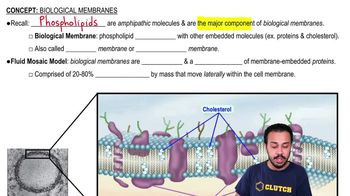
Model describing the plasma membrane as a dynamic mosaic of phospholipids, cholesterol, and proteins that move fluidly within the layer.
A solution with a higher solute concentration relative to another solution, causing cells to lose water.
A solution with a lower solute concentration relative to another solution, causing cells to gain water.
Solutions having equal solute concentrations, resulting in no net water movement across a membrane.
Membrane-enclosed organelles containing hydrolytic enzymes used to digest macromolecules and cellular debris.
Double-membrane organelles responsible for cellular respiration and ATP generation in eukaryotic cells.
Double membrane perforated by pores that encloses the nucleus, regulating passage of molecules between nucleus and cytoplasm.
The net movement of water molecules across a selectively permeable membrane from an area of higher water potential to lower water potential.
Movement of substances across a membrane along their concentration gradient without cellular energy expenditure.
Form of endocytosis where large particles or cells are engulfed by pseudopodia into a food vacuole ('cell eating').
Form of endocytosis where extracellular fluid containing dissolved solutes is taken into small vesicles ('cell drinking').
A selectively permeable phospholipid bilayer with embedded proteins separating the cytoplasm from the external environment.
In walled cells, the plasma membrane pulls away from the cell wall due to water loss in a hypertonic environment.
Force exerted outward against a cell wall by fluid inside the cell pushing against the plasma membrane.
Metric predicting net water flow direction, influenced by solute concentration and applied pressure.