 Indietro
General Biology - Cellular Energy and Metabolism
 04:21

Termini in questo insieme (23)
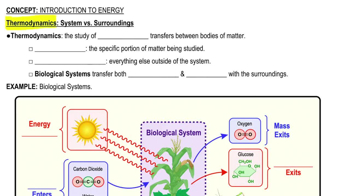
Energy and matter cannot be created or destroyed, only transformed. Organisms use energy from the sun or chemical bonds to perform cellular work.
In any closed system, entropy tends to increase. Living systems are open systems that use energy to maintain order and decrease internal entropy.
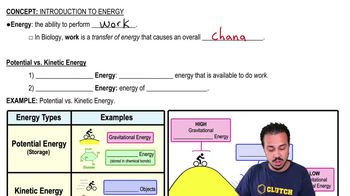
Kinetic energy is energy of motion (e.g., thermal energy). Potential energy is stored energy (e.g., chemical energy in bonds).
Free energy change is given by \(\Delta G = \Delta H - T\Delta S\), where G is free energy, H is enthalpy, T is temperature, and S is entropy.
Reactions that release energy, occur spontaneously, and have a negative change in free energy (\(\Delta G < 0\)).
Reactions that require energy input, are non-spontaneous, and have a positive change in free energy (\(\Delta G > 0\)).
Linking an exergonic reaction to an endergonic one so the overall process is spontaneous (\(\Delta G < 0\)), often via ATP phosphorylation.
ATP consists of adenine, ribose, and three phosphate groups. Hydrolysis of ATP releases energy used to power cellular work.
ATP + H2O → ADP + Pi + energy. The breaking of the terminal phosphate bond releases energy for cellular processes.
ATP powers transport work (moving solutes), mechanical work (motor proteins moving vesicles), and chemical work (endergonic reactions).
The sum of all chemical reactions in an organism, including catabolic (energy-releasing) and anabolic (energy-consuming) pathways.
The energy input required to reach the transition state and start a chemical reaction by breaking bonds.
Substances that speed up reactions by lowering activation energy without being consumed.
Protein macromolecules that act as catalysts to speed up specific reactions by stabilizing the transition state.
The specific region on an enzyme where substrates bind and the reaction is catalyzed.
Substrate binding induces a conformational change in the enzyme, optimizing the fit and catalytic activity.
Non-protein helpers required by some enzymes, including inorganic ions (minerals) and organic molecules (coenzymes like vitamins).
Enzymes can be regulated by competitive inhibitors (bind active site), non-competitive inhibitors, and allosteric interactions that change enzyme shape.
Binding of molecules at sites other than the active site that stabilize the enzyme in active or inactive conformations.
Substrate binding to one active site increases the activity of other active sites in a multi-subunit enzyme.
The end product of a metabolic pathway inhibits an enzyme early in the pathway to prevent overproduction.
Cellular compartments localize enzymes and pathways, increasing efficiency and order in metabolism.
Enzyme activity and structure are affected by temperature, pH, and concentrations of enzyme, substrate, and cofactors.