 Indietro
General Biology: Cellular Respiration & Photosynthesis
 01:53

Termini in questo insieme (25)
To convert biochemical energy from nutrients into ATP, the cell's energy currency.
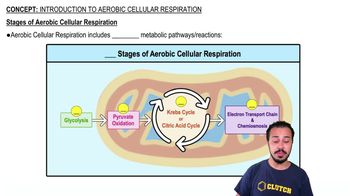
In the cytosol.
2 pyruvate, 2 ATP (via substrate-level phosphorylation), and 2 NADH.
Pyruvate is converted to acetyl-CoA in mitochondria, producing NADH and releasing CO2.
2 ATP, 6 NADH, 2 FADH2, and 4 CO2.
Transfers electrons from NADH and FADH2, pumps protons to create a proton gradient used by ATP synthase to produce ATP.
About 26-28 ATP molecules.
Direct transfer of a phosphate group to ADP during glycolysis and the citric acid cycle to form ATP.
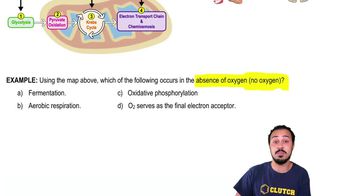
An anaerobic process that regenerates NAD+ to sustain ATP production when oxygen is unavailable.
Lactic acid fermentation (pyruvate to lactic acid) and alcohol fermentation (pyruvate to ethanol and CO2).
Oxygen, which forms water after accepting electrons.
The process by which autotrophs convert light energy into chemical energy, producing glucose and oxygen.
In the thylakoid membranes.
ATP, NADPH, and O2 (from water splitting).
Electron carrier that transports electrons to the Calvin cycle for carbon fixation.
To fix CO2 and synthesize glucose.
3 CO2 molecules.
Chlorophyll (main pigment) and carotenes (accessory pigments).
Blue and red light.
C3 plants use the Calvin cycle directly; C4 plants fix CO2 in a separate cell layer; CAM plants fix CO2 at night to minimize water loss.
Pores on leaf surfaces that regulate gas exchange and control water loss.
Aerobic respiration produces ~30-32 ATP per glucose; fermentation produces much less ATP.
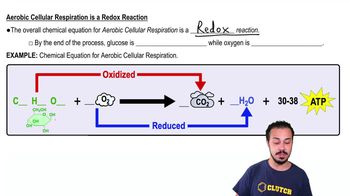
Transfer of electrons between molecules; oxidation is loss of electrons, reduction is gain of electrons.
\(6CO_2 + 6H_2O + light \rightarrow C_6H_{12}O_6 + 6O_2\)
\(C_6H_{12}O_6 + 6O_2 \rightarrow 6CO_2 + 6H_2O + ATP\)